AI Measures Topical Authority: Rank Higher Now
Learn how AI engines measure topical authority for your website. Discover strategies to boost your rankings with Snezzi's AI visibility platform.
Learn how AI engines measure topical authority for your website. Discover strategies to boost your rankings with Snezzi's AI visibility platform.
Introduction
Search engines have changed a lot in 2025. You used to rank just by putting keywords on a page. Now, artificial intelligence (AI) runs the show. AI engines like ChatGPT, Gemini, and Perplexity want to know if you are a true expert. They look for something called topical authority.
So, how AI engines measure topical authority effectively is the big question for businesses today.
Here is the short answer. AI engines measure authority by checking how deep your content goes and how well topics connect. They do not just look at one page. They look at your whole website to see if you cover a subject completely. They check if other experts trust you.
If you are asking whether AI prefers a site with many pages or one good page, the answer is clear. AI prefers a site that answers every question about a topic. This signals trust and expertise.
It works a lot like a library. A library with one book on cars is not an authority. A library with hundreds of books on engines, tires, and racing is an authority. AI wants to send users to that full library.
This guide helps your brand build that trust. We will show you how to rank higher and get found by AI tools.
To win in search today, you must think like a machine. AI helps users find the best answers fast. It does not want to guess. It wants proof that you know your stuff.
Topical authority is a measure of your expertise. It shows you know a subject inside and out. It is not about being famous. It is about being helpful and complete.
You build this by writing about a main topic and all its smaller parts. Our guide on building content clusters LLMs understand explains this approach in detail.
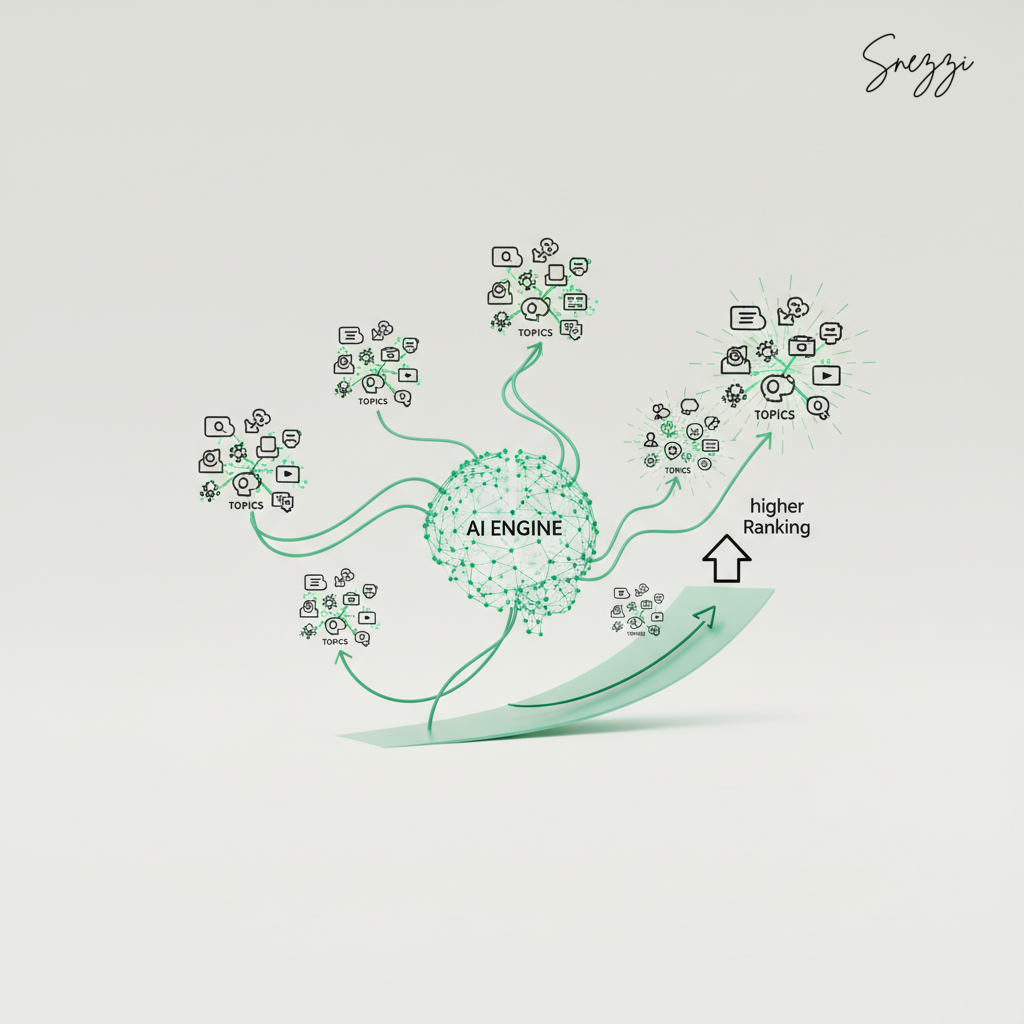
Topical authority shows expertise in specific subjects through content depth and semantic relationships. This means your pages must talk to each other. They should link together in a way that makes sense. When you do this, AI sees a map of knowledge.
A report from Search Engine Journal notes that semantic depth is key to this process. It helps search engines understand the context of your words. It is not just about using a keyword many times. It is about using the right related words.
AI tools have one goal. They want to give the best answer immediately. They cannot afford to be wrong.
If an AI gives bad advice, people stop using it. That is why they are so strict about authority. They prioritize sites that have proven they are correct over time.
Recent data shows how much this matters. AI systems cite 76.1% of their answers from the top 10 organic results. This finding from Ahrefs research proves that traditional ranking signals still matter to AI. If you rank high on Google, AI is more likely to trust you. Learn more about generative engine ranking factors.
Pro Tip: Do not just write for robots. Write to answer real questions from real people. AI follows user behavior. If people trust you, AI will too.
AI uses complex math to judge your site. It looks for specific signs of quality. We call these signals.
The most important framework is E-E-A-T. This stands for Experience, Expertise, Authoritativeness, and Trustworthiness.
AI evaluates E-E-A-T through content comprehensiveness, entity relationships, and co-occurrence patterns. This might sound hard, but it is simple.
Experts at Moz explain that these patterns tell the AI you belong in the conversation. If you run a bakery, you should talk about flour, yeast, and ovens. If you talk about tires, the AI gets confused.
AI engines are smart readers. They read your content faster than any human. They look for AI search content depth to define who is the leader in a market.
AI does not guess how much you know. It measures it. It looks at the length and detail of your work.
Search engines assess topical authority E-E-A-T via content length indicating comprehensive coverage. But long content is not always good content. It must be useful.
If you write about “coffee,” a short post is not enough. To be an authority, you need to cover beans, brewing, roasting, and serving. You need breadth. Breadth means covering many related sub-topics.
Think of your website as a spider web. The stronger the web, the more flies it catches. A site with thin content has a weak web. AI engines fly right through it without stopping.
Links are like votes. When another site links to you, they are vetting you. AI counts these votes to decide who wins.
Backlinks from topic-relevant authoritative sources signal topical authority backlinks AI to algorithms.
It matters who links to you. A link from a famous newspaper is worth a lot. A link from a random blog is worth little.
A study by Moz highlights that these external validations are crucial. They tell the AI that other humans trust what you say. It is social proof for machines.
However, you cannot just buy links. You must earn them with great content.
AI also watches how people act on your site. Do they stay and read? Or do they leave fast?
User engagement topical authority is a huge factor. If people spend time on your page, it means you answered their question.
Dwell time and CTR (Click-Through Rate) serve as metrics that indicate long-term user engagement.
Experts at Keyword Insights note that these signals are query-independent. This means they matter for every topic. If users trust you, the AI assumes your content is good.
Key Insight: Fast loading speeds and easy reading help user engagement. If your site is slow, people leave. AI sees this exit and lowers your rank.
Now you know what AI looks for. The next step is to build it. This takes time, but it is worth it. You need a plan to show AI engines expertise signals.
You cannot write random posts anymore. You need a structure. The best way to do this is with topic clusters.
A topic cluster has one main page and many support pages. The main page covers the big idea. The support pages explain the details.
Content clusters with pillar pages and subtopics show comprehensive expertise. This model helps AI understand your site structure.
For example, if you sell shoes, your main page is “Running Shoes.” Your sub-pages are “Best Shoes for Trails,” “How to Size Shoes,” and “Shoe Care.”
Research from Search Atlas confirms that this method works. It organizes your site so machines can read it easily. For practical steps, read write content AI assistants will quote.
You need friends in your industry. You need them to link to you. This builds your reputation.
But you also need to link to yourself. This is called internal linking.
Internal linking helps reinforce semantic relationships recognized by AI systems. It connects your ideas.
When you link “Running Shoes” to “Shoe Care,” you make a connection. You tell the AI these two things are related.
For large companies, this can be hard to manage. If you have thousands of pages, you need a strong system. The Enterprise Plan from Snezzi helps large teams organize these authority signals at scale.
AI serves users who want answers now. You must write for them.
Use clear headings. Use lists. Answer questions directly. This is semantic relevance AI search in action.
You also need to stay current. Old news is bad news for AI.
Regular updates signal ongoing expertise to AI favoring current information. Check out our guide on how to measure GEO visibility to track your progress.
Search Atlas data suggests that fresh content ranks better. Go back to your old posts once a year. Update the facts. Fix the broken links. Add the current year, 2025, to show it is new.
This maintenance tells AI you are still active. It shows you care about accuracy.
Building authority is hard work. measuring it is even harder. You cannot see what the AI sees without help. This is where Snezzi comes in.
Snezzi helps you see your brand through the eyes of an AI. It tracks how often you appear in AI answers so you can improve.
Snezzi looks at data that traditional tools miss. It tracks mentions in chat apps and answer engines.
One key metric is entity salience. This measures how important your brand is to a specific topic.
Entity metrics score topical alignment based on semantic relevance. This parallels what top SEO experts prioritize.
Snezzi helps you check if AI connects your brand to your products.
Top industry expert Szymon Slowik notes that entity metrics are vital for modern SEO. Snezzi simplifies this complex data for you.
If you are a growing team, you need to move fast. You need to know what works today.
Using the Growth Plan allows you to track these trends. You can see which articles bring you the most AI traffic. You can spot gaps in your content.
For example, Snezzi might show that AI loves your “How-To” guides but ignores your product pages. You can then fix your product pages to match the guides.
Small businesses have tight budgets. You cannot waste time on bad strategies. You need focused, clear data.
The Business Plan is great for deeper competitive analysis. It shows you exactly who you are fighting against in the AI space.
This tool takes the guesswork out of topical clusters AI ranking. You focus on creating content; Snezzi handles the data.
The rules will keep changing. AI is getting smarter every day.
In the future, authority might come from video or audio, not just text. AI will listen to podcasts to find experts. It will watch videos to learn skills.
You must stay flexible. Keep learning. Keep creating.
The goal remains the same. Be the best answer. If you are the best answer, the AI will find you.
Focus on value. Focus on trust. Focus on your user.
AI models look for three main things. They check content depth, semantic connections between pages, and trust signals like backlinks. These factors combine to create an authority score for your domain.
Yes, updating content is critical. Regular updates signal to AI engines that your information is current and accurate for 2025. This freshness prevents your authority score from decaying over time.
Yes, a small site can beat a big site if it is more focused. If you cover a niche topic completely with semantic relevance AI search, AI will view you as the expert. You do not need millions of pages to rank.
Keyword density counts words, while topical authority measures meaning. Authority looks at how well you explain concepts and connect ideas. It is about the quality of information, not just repeating terms.
Building true authority takes months of consistent effort. You must publish quality content regularly and earn trust from other sites. It is a long-term strategy, not a quick fix.
Internal links are vital for success. They act as a map for AI crawlers to find and connect your content. They transfer value from your strong pages to your new pages.
Understanding how AI engines measure topical authority is the key to growth in 2025. It is no longer about tricks. It is about truth.
AI wants to serve its users the accurate, helpful information. Your job is to provide that.
Start by auditing your content. Look for gaps. Build clusters that cover every angle of your topic. Earn links from trusted friends in your industry. For a complete framework, see the GEO blueprint for content marketers.
Remember to track your progress. You cannot improve what you do not measure. Tools like Snezzi give you the vision you need to win.
If you are ready to take control of your AI presence, start today. Build your library. prove your worth. The AI engines are waiting to discover you.
Ready to see what the AI sees? Get your free website audit from Snezzi today and take charge of your digital future.