AI Search vs Google: Who's Winning Visibility in 2026?
Explore who's winning in AI search results versus Google. Understand the evolving landscape of AI search and how to optimize your brand's visibility in 2026.
Explore who's winning in AI search results versus Google. Understand the evolving landscape of AI search and how to optimize your brand's visibility in 2026.
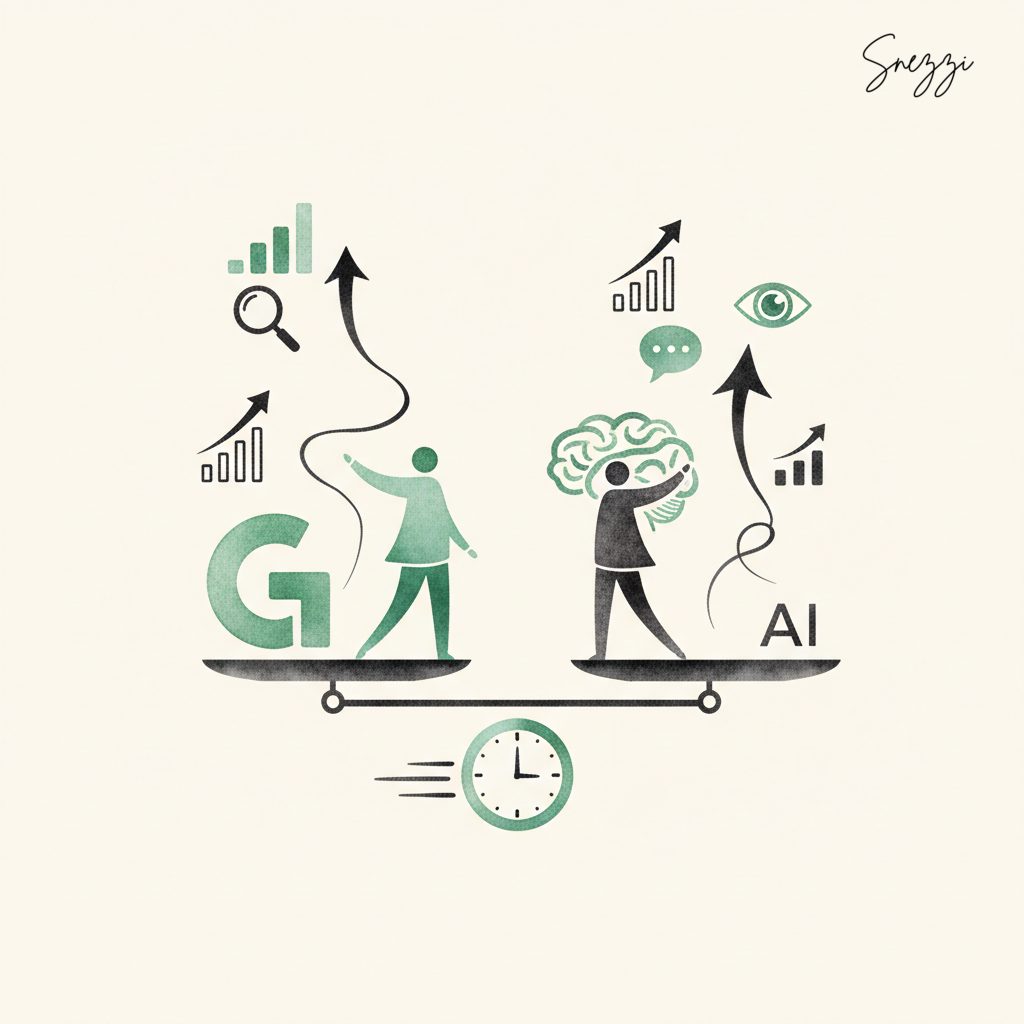
Who’s winning in AI search results vs Google? This is the big question for 2026.
Here is the short answer. Google still has the most users, but AI engines are winning on complex questions. Platforms like ChatGPT and Perplexity give direct answers. They don’t just give you a list of links. AI search uses deep context to understand what you mean. Google is fighting back with its own AI Overviews. For businesses, “winning” now means appearing in both places. You must optimize for traditional search and the new Generative Engine Optimization (GEO).
If you are asking where to focus, here is the truth. You cannot ignore either one. Google is for volume. AI is for detailed answers. To win today, you need a strategy for both styles of search.
Search habits are changing fast. People don’t just type keywords anymore. They have conversations with search engines. This shift changes how brands get found online.
AI search engines are new, but they are growing. They work differently than the old search bars. You ask a question, and the AI writes an answer. It pulls facts from many sites to do this.
Traditional search engines list websites. AI search engines give answers. This is a big change for businesses.
According to recent data, ChatGPT now captures 17.1% of digital queries compared to Google’s 77.9%. But don’t let Google’s larger number fool you. The people using AI tools are highly engaged. ChatGPT users spend an average of 13 minutes per session compared to just 6 minutes on Google. They are looking for specific solutions, not just browsing.
The biggest difference is how they read your content. Old search engines look for keywords. If you type “best shoes,” they look for that phrase.
AI is smarter. AI search uses semantic context to understand complex questions. It knows that “shoes for sore feet” means you need comfort. It reads the meaning, not just the words. This means your content must answer real problems. It cannot just be full of keywords.
Key Difference:
We can see the shift happening now. People want quick answers. They don’t want to click five different links.
AI Overviews became very popular very fast. Google’s AI Overviews now reach 2 billion users monthly, transforming how people find information. If your site does not show up in that overview, you are invisible. This trend predicts a future where direct answers rule the market.
Google is not standing still. They see the threat from AI tools. They are changing their whole system to keep up.
Google search looks different today than it did two years ago. You see AI summaries at the top of the page. This is their way of keeping you on their site.
Google is using its Gemini model to do this. Google brought Gemini 3 to AI Mode in Search with more complex reasoning and new dynamic experiences. This helps the engine answer hard questions in one try. For example, you can ask for a meal plan and a shopping list at once. Google can now do both. This keeps them relevant against tools like ChatGPT.
Where is this going this year? The line between “chat” and “search” will blur. Every search engine will be an answer engine.
Experts see the market shifting. Gartner predicts traditional search engine volume will drop 25% by 2026 due to AI chatbots and virtual agents. This might seem dramatic, but it is real. It represents millions of users leaving traditional search. This growth shows that AI is a real competitor, not just a fad.
You might worry about losing traffic. If AI gives the answer, will people click your site? This is a valid fear.
Data shows traffic patterns are changing. Organic CTR for AI Overview queries declined 61% year-over-year, according to Seer Interactive’s research. This means fewer people are clicking purely informational links. To fix this, you must offer more value. You need deep guides, unique data, and expert views. AI can summarize facts, but it cannot replace human experience.
Pro Tip: Don’t just write facts. Write about experiences. AI can list ingredients. Only a human can tell you how the cake tastes.
This is the most important part. You know the landscape is changing. Now you need to know how to win. Who’s winning in AI search results vs Google? The brands that adapt fast.
You need to know where your customers are looking. Are they asking Google? Or are they asking a chatbot?
More people are choosing AI on purpose. ChatGPT dominates generative tasks, capturing 64% of creative query volume compared to Google’s 29%. They trust it to filter out the noise. This is your opportunity. You need to be the source the AI trusts. This requires high-quality, verified information on your site. Learn more about how AI chatbots pick sources.
This new world can be hard to track. Traditional tools don’t tell you if ChatGPT likes your brand. You need better data.
This is where Snezzi helps. It is a platform that tracks your visibility across AI engines. It tells you what AI thinks of your business. If you are a specific business looking to scale, you can use the Growth Plan to see where you stand. It helps you spot gaps in your content.
For larger teams, it gets more complex. You have more pages and more products. Snezzi offers a Business Plan that helps teams monitor brand mentions in real-time across multiple AI channels at once. It helps you control the narrative about your brand. Tracking these metrics is the only way to safeguard your future traffic.
To get picked by AI, your website must be clean. The code needs to be easy for bots to read.
You should use “structured data.” This is like a label for search engines. According to Search Engine Land, only pages with well-implemented schema appeared in AI Overviews in controlled experiments. It tells the AI, “This is a price,” or “This is a rating.” When the AI understands your data, it is more likely to use it in an answer. Check out our guide on structured data for AI search.
Quick Action List:
The competition is fierce. Everyone wants to be the “cited source” in the AI answer. You need to measure your wins carefully.
Old metrics can trick you. You might see fewer clicks but have more brand awareness. This is the new reality.
Traditional tools are failing. The Seer Interactive study found that even non-AI queries experienced a 41% decline in organic CTR year-over-year. You cannot just count page views anymore. You need to count “mentions” and “citations.” This is why specialized tracking is vital. Tools that track traditional ranks will miss your AI wins.
For large companies, this data is critical. You cannot guess. You need the deep insights found in the Enterprise Plan to track global AI sentiment. This allows you to future-proof your strategy against sudden algorithm changes. Learn how to measure your GEO visibility.
This trend is not stopping. It will only accelerate. You need a plan for the next five years, not just next month.
The market is exploding. The AI search engines market will grow at 14% CAGR until 2032, reaching over $108 billion. This means AI is here to stay. Brands that ignore it will vanish. Brands that adapt will thrive.
If you are a small business, you might feel overwhelmed. It is okay to start small. You can start with a Growth Plan to get the basics right. The key is to start now. Don’t wait for your competitors to take your spot.
Key Insight: Visibility is the new click. Even if they don’t click, they see your brand name. That builds trust over time.
It is unlikely they will fully replace Google soon. Google is adapting by adding its own AI features. However, AI engines will likely take a large share of specific question searches.
You must write clear, factual content that answers questions directly. Use structured data to help bots read your site. Ensure your brand is cited by other trusted websites.
SEO focuses on ranking links on a page. GEO (Generative Engine Optimization) focuses on becoming the cited answer in an AI summary. GEO requires more authority and direct facts.
Yes, it is often more valuable than regular search traffic. Users using AI are usually looking for specific answers to take action. They have higher intent than casual browsers.
Yes, traditional analytic tools cannot see inside chat interfaces. You need specialized platforms to know if an AI is recommending your brand.
AI Overviews might be answering the user’s question directly on the search page. This leads to “zero-click” searches. You need to optimize for brand visibility, not just clicks.
Who’s winning in AI search results vs Google? The winner is the brand that optimizes for both.
The search landscape in 2026 is a hybrid world. Google still owns the volume. AI owns the engagement. You cannot afford to choose sides. You must build a presence that works for algorithms and artificial intelligence. This means clear writing, structured data, and constant monitoring.
Don’t fly blind in this new era. You need to know what the AI models are saying about you. Take control of your digital reputation today. Check out Snezzi to see your true visibility score. Start optimizing for the future of search right now.