Build Content Clusters LLMs Understand
Learn how to build content clusters that AI models like ChatGPT and Claude can understand for better online visibility. Optimize your content strategy with Snezzi.
Learn how to build content clusters that AI models like ChatGPT and Claude can understand for better online visibility. Optimize your content strategy with Snezzi.
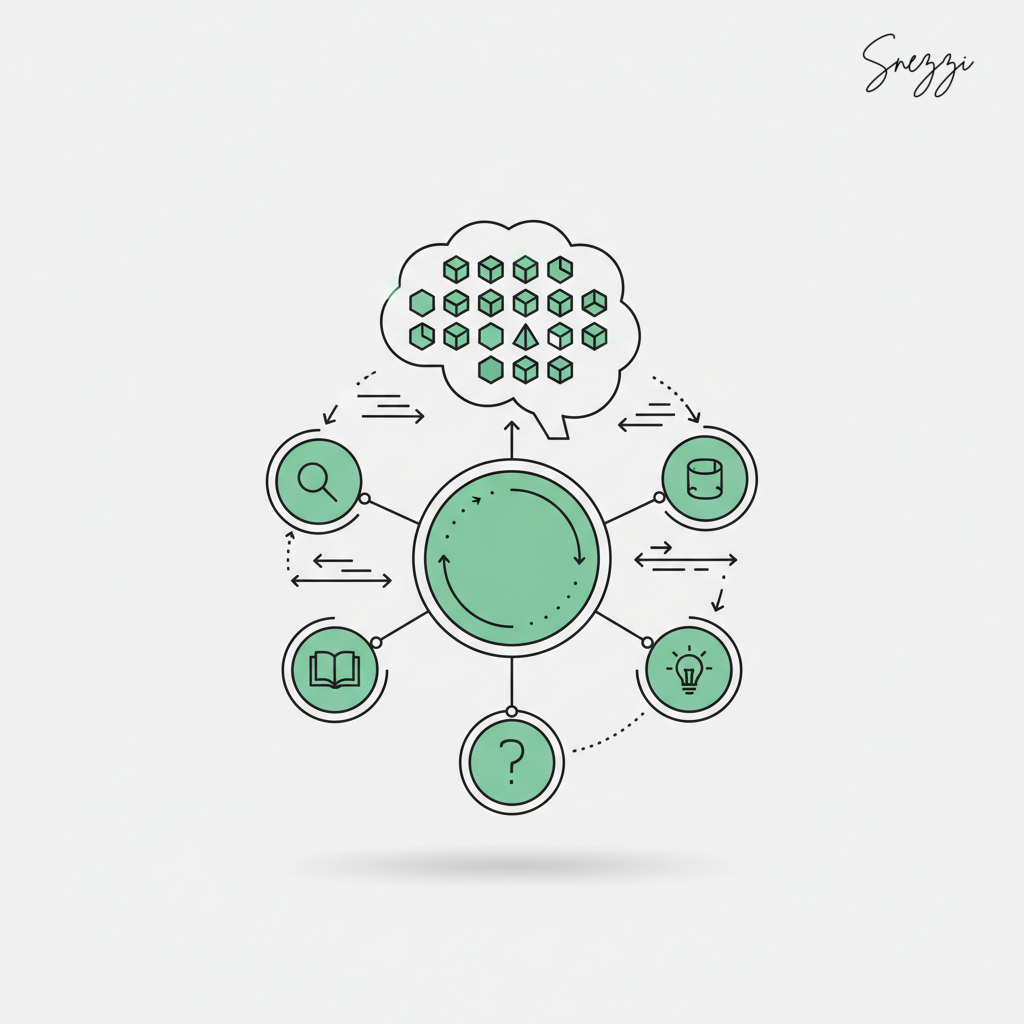
The digital landscape is undergoing a seismic shift, moving rapidly from traditional search engine indexing to complex neural network processing. For over two decades, marketers have optimized for algorithms that count backlinks and match keywords, but the rise of Large Language Models (LLMs) requires a fundamentally different approach. Today, learning how to build content clusters AI models actually understand is no longer just an experimental strategy; it is a critical necessity for survival in the age of generative search.
When a user asks ChatGPT or Claude a question, the AI doesn’t simply scan a list of blue links. Instead, it predicts the most probable, factually accurate answer based on vector embeddings—mathematical representations of how concepts relate to one another. If your content is siloed or lacks deep semantic connection, it effectively becomes invisible to these models. According to the Princeton GEO study published at KDD 2024, models prioritize information that demonstrates high “contextual proximity” to the query, favoring depth and structural logic over mere keyword frequency. This research demonstrated that proper optimization can boost visibility in AI responses by up to 40%. This makes the architecture of your site just as important as the words on the page.
This guide will walk you through the advanced mechanics of Generative Engine Optimization (GEO), helping you transform your digital presence into an authoritative source that AI platforms prefer to cite. If you’re wondering how GEO differs from traditional SEO, this represents a fundamental shift in optimization strategy. For marketers looking for an end-to-end approach, our GEO blueprint for content marketers provides a complete framework.
To master how to build content clusters AI models actually understand, you must first unlearn the rigid rules of traditional SEO. Legacy search engines work like an index in the back of a textbook: they look for specific words and point you to the page number. In contrast, AI models function like a library’s expert reference librarian—they have read the books, synthesized the information, and can explain the concepts without needing to open the text again.
LLMs operate in “vector space.” In this multi-dimensional mathematical environment, words and concepts that share semantic meaning are grouped closer together. For example, a traditional search engine acts on specific queries like “best running shoes.” An AI model, however, understands the vector relationship between “running,” “marathon training,” “joint health,” and “shock absorption.”
If your content cluster only addresses “running shoes” without connecting to the semantically related concepts of health, training, and terrain, the AI views your content as shallow. It assigns a lower probability score to your content, making it less likely to be used in a generated response.
Comparison: Traditional SEO vs. AI-First Content Modeling
| Feature | Traditional SEO Clusters | AI-Ready Semantic Clusters |
|---|---|---|
| Primary Goal | Ranking for specific keywords | Establishing topical authority and entity relationships |
| Structure | Linear (Pillar -> Sub-topic) | Networked (Interconnected nodes of logic) |
| Optimization | Keyword density and placement | Contextual depth and vector proximity |
| Success Metric | Click-Through Rate (CTR) | Citation frequency in AI responses |
| Formatting | Skimmable for humans | Structured data for machine parsing |
AI models don’t think in strings of text; they think in “entities.” An entity is a distinct concept—a person, place, thing, or idea—that the AI recognizes as unique. To optimize for this, your content must clearly define entities and their relationships. For a deeper dive into this concept, explore our guide on entity optimization for LLMs.
Pro Tip: When structuring your cluster, explicitly define the relationship between entities in your introductory paragraphs. Instead of saying “Our software helps you,” say “[Product Name] is a SaaS platform designed for [Specific User] to solve [Specific Problem].” This reduces ambiguity and helps the AI map your brand entity correctly.
Knowing how to build content clusters AI models actually understand requires a move toward “Knowledge Graph” architecture. You are effectively building a mini-wikipedia for your specific niche that the AI can traverse easily. This improves your visibility on platforms like Perplexity, Gemini, and ChatGPT. For practical guidance on optimizing for specific platforms, see our Perplexity optimization guide and ChatGPT SEO techniques.
Every AI model relies on high-confidence data points to ground its answers. Your pillar content needs to serve as this source of truth. Unlike standard blog posts that offer vague advice, an AI-ready pillar page should be dense with proprietary data, clear definitions, and unique methodologies.
For example, if you are in the digital marketing space, do not just write about “visibility.” Define it, measure it, and create a framework for it. This is where platforms like Snezzi become vital. By using tools that focus on AI visibility tracking, you can identify exactly which entities and “fact sets” competitors are dominating. By analyzing competitive intelligence, you can structure your core content to answer questions your competitors have ignored.
Once your core fact set is established, you must build bridge content. These are supporting articles that link your core entity to broader user intents. However, the internal linking must be logic-based, not just opportunistic.
How to structure bridge content:
While AI is smart, it appreciates help. Implementing robust schema markup (JSON-LD) is like handing the AI a map of your content cluster. You should use Article, FAQPage, and most importantly, Organization and Product schema. Learn more about implementation in our structured data guide for AI search engines and our step-by-step FAQ schema tutorial.
Make sure your schema explicitly states sameAs links to your social profiles and Wikipedia pages (if available). This creates a “Knowledge Graph” triangulation that confirms your brand is a legitimate entity worth citing.
The final piece of the puzzle in learning how to build content clusters AI models actually understand is validation. AI models are programmed to minimize “hallucinations” (false information). To do this, they prioritize content that appears factually consistent with other authoritative sources.
AI models determine truth through consensus. If your content makes a unique claim, back it up with a citation to a high-authority domain (like a government site, a university study, or a major industry report). Conversely, you want to become a source that others cite. Understanding how AI chatbots pick sources is crucial for this strategy. For best practices on building this citation authority, see our guide on getting citations right in AI-generated answers.
This creates a “Citation Loop.” When an AI sees your content linking to trusted sources, and sees other trusted sources linking to you, it assigns a high “trust score” to your information.
Optimizing for AI is difficult because, unlike Google Search Console, there is no native dashboard for ChatGPT or Claude. You cannot usually see when an AI recommends your brand or synthesizes your content.
This is where specialized tools become essential for growing teams and enterprises. Snezzi provides a complete solution for this “invisible” ecosystem. By utilizing the Growth plan or Aggressive plan, businesses can access citation source intelligence and track how widely their brand is being recommended across different AI platforms. For a comprehensive overview of tracking tools, see our guide to GEO dashboards and analytics.
Without a tool like Snezzi, you are essentially flying blind, unable to see if your content clusters are effectively influencing the AI models or if your competitors are capturing the narrative.
Pro Tip: Periodically test your content by asking detailed queries in Perplexity or Claude related to your niche. If the AI hallucinates or gives generic answers, your content cluster likely lacks specific “information gain.” You need to add more distinct, unique details to your articles.
While we focus on machines, remember that modern AI models, specifically those used by Google (Search Generative Experience) and Bing, also look at user engagement signals. If users dwell on your page, interact with your tools, and share your content, these signals reinforce the validity of the data.
Checklist for High-Utility Content:
Traditional SEO focuses on ranking for keywords by satisfying a search engine’s indexing algorithm, primarily through backlinks and keyword placement. AI-based optimization, or Generative Engine Optimization (GEO), focuses on optimizing content for Large Language Models (LLMs) by prioritizing entity relationships, structural clarity, and semantic depth to ensure the AI “understands” and cites the content.
Unlike search engine crawlers that can index a page in hours, LLMs often have training cut-off dates or update cycles that can take weeks or months. However, retrieval-augmented generation (RAG) engines like Bing Chat or Perplexity can access live web data almost immediately, provided your site has high crawlability and technical structure.
While you don’t need to be a developer, understanding the basics of structured data (Schema markup) is highly beneficial. You focus on the quality and structure of the writing (logical hierarchy, clear definitions), while tools or plugins can handle the technical implementation of schema to help machines parse your content.
Yes, existing content is a goldmine for AI optimization if updated correctly. You should audit old posts to ensure they clearly define entities, answer questions directly in the introduction, and link strictly to authoritative sources, effectively restructuring them into a cohesive cluster rather than standalone articles.
Tracking AI citations is difficult without specialized software because standard analytics tools don’t capture “chat” views. Platforms like Snezzi are designed specifically to solve this, offering visibility tracking and optimization recommendations to show you exactly how and where your brand appears in AI-generated responses.
Keyword density is far less important than “semantic density.” Instead of repeating the same phrase, you should focus on covering the topic comprehensively using related concepts, synonyms, and contextual terms that prove to the AI you have covered the subject in depth.
The most common mistake is creating surface-level content that lacks “information gain.” If your content simply repeats what is already on Wikipedia or top-ranking sites, the AI has no incentive to reference it; you must provide unique data, original angles, or proprietary insights to be deemed worthy of citation.
The transition from search engines to answer engines is not just a trend; it is the new reality of digital discovery. Mastering how to build content clusters AI models actually understand requires a deliberate shift from chasing algorithms to building genuine, structured authority. By focusing on entity relationships, implementing robust schema, and ensuring your content provides high-confidence data, you position your brand to be the answer, not just a link.
In this new ecosystem, visibility is binary: you are either the trusted source the AI references, or you are invisible. Don’t leave your digital presence to chance. For businesses ready to take control of their narrative in the AI age, the Snezzi Custom plan offers the robust tracking and optimization insights needed to stay ahead.
Start building your semantic authority today. Analyze your current content, bridge the gaps in your logic, and equip your business with the tools necessary to monitor your success in the era of artificial intelligence.