Future of AI Search: 5 Shifts Reshaping SEO
Discover the future of AI search with 5 key shifts transforming SEO planning. Adapt strategies for ChatGPT, Perplexity, and more to boost visibility—powered by Snezzi insights.
Discover the future of AI search with 5 key shifts transforming SEO planning. Adapt strategies for ChatGPT, Perplexity, and more to boost visibility—powered by Snezzi insights.
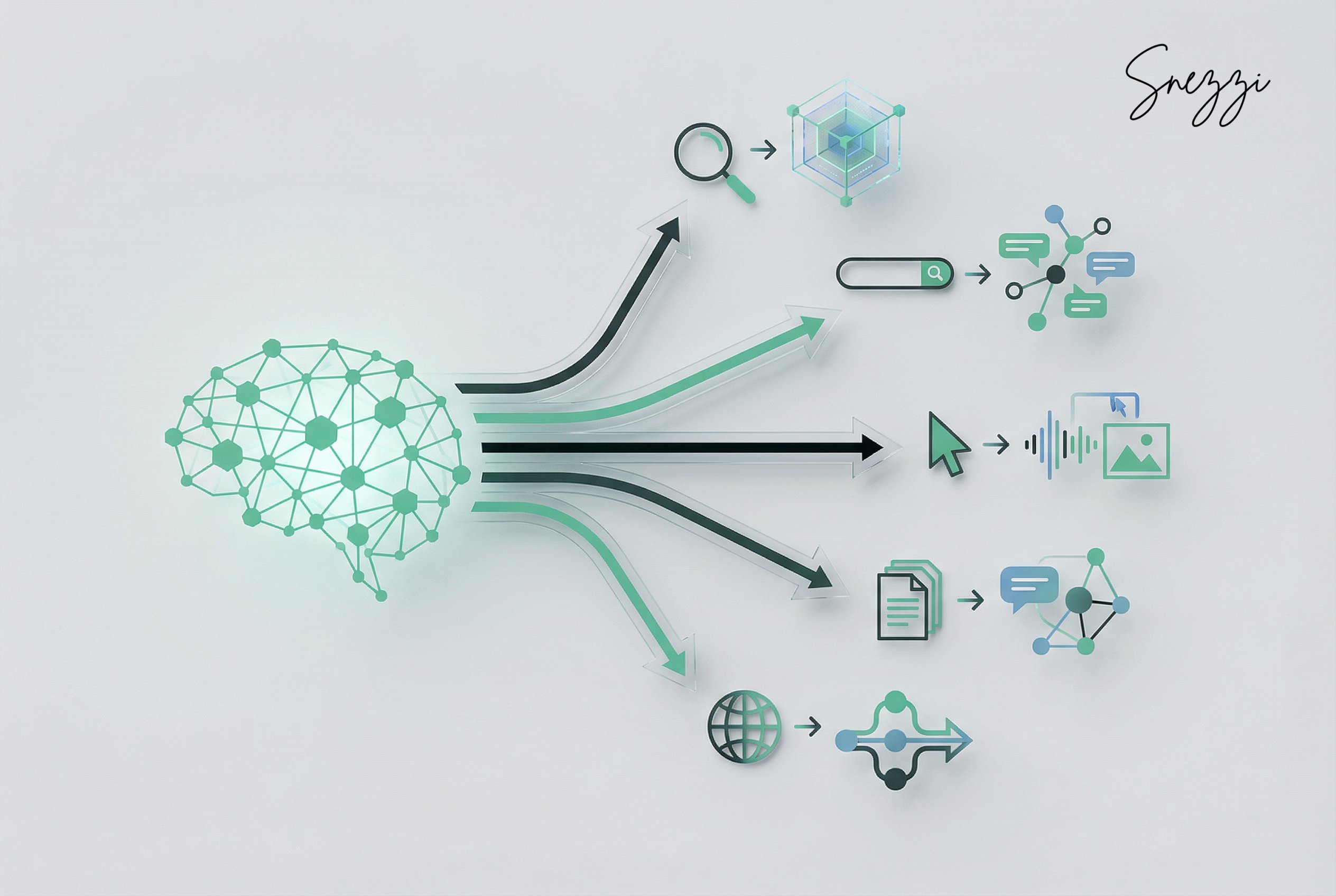
The future of AI search isn’t approaching—it’s already here, fundamentally restructuring how businesses earn visibility online. Half of all consumers now use AI-powered search, with platforms like ChatGPT serving 810 million daily users and Google AI Overviews reaching 1.5 billion monthly users. Traditional SEO focused on earning clicks. The future of AI search demands optimizing for citations, agent readability, and synthesized answers that keep users inside AI platforms.
Five fundamental shifts are reshaping this landscape. Understanding them separates businesses that maintain visibility from those that disappear as search evolves beyond the traditional link-based model.
AI search has moved from experimental to dominant faster than any previous search evolution. ChatGPT alone handles 810 million daily users, while Google AI Overviews appear in 67% of US searches—up from 42% just one year ago. The shift from navigation to synthesis defines this transformation.
Traditional search presented a list of links. You evaluated, clicked, and browsed. AI search delivers a singular synthesized answer drawn from multiple sources, often eliminating the need to click through entirely. Understanding how AI search compares to Google reveals just how dramatic this transition has become. Zero-click searches now represent roughly 80% of queries that trigger AI Overviews, cutting outbound clicks from 15% to just 8%.
Perplexity CEO Aravind Srinivas describes this evolution precisely: his platform functions as “an answer engine” where “all the answers are backed by sources.” Users aren’t choosing between ten blue links anymore. They’re receiving confident, citation-backed responses that answer their questions without requiring them to leave the AI interface.
Yet habits die hard. Research shows users still default to Google for most searches, then supplement with AI tools for complex tasks. This hybrid behavior won’t last. As AI platforms prove their reliability and speed, the balance will tip decisively toward synthesized answers over traditional browsing.
The future of AI search speaks your language—literally. Voice inputs, image uploads, and video queries are surging as users realize they don’t need to translate their questions into keyword-ese anymore. You.com CEO Richard Socher captured the surprise perfectly: “The most amazing surprise was when ChatGPT came out… it could just be pure text… the search landscape is clearly changing.”
Conversational queries now return AI answers 60% of the time, compared to just 37% for keyword-style statements. Users ask complete questions. They describe problems in natural language. They upload photos of broken appliances or screenshots of error messages and expect AI to diagnose the issue.
YouTube ranks third for information discovery among AI search users, signaling that video and audio content will become citation sources as models improve multimodal understanding. This means optimizing video transcripts, image alt text, and audio content for machine comprehension matters as much as traditional on-page text.
The SEO implications run deep. Keywords still matter, but context matters more. AI models evaluate semantic meaning, user intent, and content depth rather than exact-match phrases. Content that answers “why” and “how” questions in natural, detailed language outperforms keyword-stuffed pages optimized for a previous era of search.
Two people asking identical questions will soon receive completely different answers. That’s not a bug in the future of AI search—it’s the core feature. Personalization is becoming the operating system, not just a ranking signal.
Google’s nested learning systems now analyze user behavior across multiple time horizons. Fast signals like session behavior sit atop slower models that track how you think, decide, and revisit information over weeks and months. The system adapts itself to each user, not just the results.
By 2028, AI summaries will appear in 75% of Google searches, up from 50% today. Each summary will be dynamically generated based on the searcher’s history, preferences, and inferred expertise level. A novice researching a topic sees simplified explanations. An expert sees technical depth and advanced sources.
This kills the concept of a single “Position 1” ranking. Your content might dominate for high-value buyers while remaining invisible to casual browsers. Performance will vary by audience segment, creating hidden pipeline risks that traditional rank tracking won’t catch.
Building niche authority becomes essential. AI models favor sources that demonstrate consistent expertise in specific domains. Broad, generic content loses to focused, authoritative material that proves deep knowledge through structured data, clear content hierarchy, and cited expertise.
AI agents don’t just find information anymore. They complete transactions, book appointments, compare prices, and execute purchases without human intervention. This represents the most disruptive shift in the future of AI search.
“We’re already seeing a massive rise in agentic crawlers—AI that searches and acts on behalf of users,” explains BrightEdge CEO Jim Yu. “Brands need to prepare now with structured data, clear content hierarchy, and machine-readable information.”
The agentic web moves users from discovery directly to transaction within a single conversation. OpenAI’s Agentic Commerce Protocol lets Shopify merchants enable checkout with one line of code. The user never leaves ChatGPT. The agent finds products, applies coupons, selects sizes, and completes the purchase autonomously.
This explains why AI chatbots drive 96% less referral traffic than traditional Google search. Agents don’t send users to your website—they extract what they need through APIs and structured data, then act on it directly.
Optimizing for agents means making your inventory, pricing, availability, and product specifications machine-readable in real time. If an agent can’t parse your data programmatically, you don’t exist in this transaction layer. SEO for workflows and API compatibility becomes as critical as on-page optimization ever was. Our guide on AI crawlability for generative search walks through making your content accessible to these agentic systems.
The future of AI search fragments authority across thousands of specialized sources rather than concentrating it in a few dominant domains. Yet paradoxically, AI currently favors the top 1,000 websites, citing long-tail sources far less frequently than traditional search did.
This creates both opportunity and challenge. User-generated content, niche databases, and proprietary research gain citation potential if they offer unique data AI models can’t find elsewhere. Generic content aggregators lose ground.
Brand-owned knowledge graphs represent the next frontier. Rather than hoping AI models discover and cite your content, you can structure proprietary data that models must access through partnerships or API agreements. Entity optimization for LLMs is a practical starting point for building this kind of structured brand presence. Only 16% of brands currently track AI search performance systematically, creating a massive first-mover advantage for those who build these systems now.
Real-time verification needs intensify as AI exposure increases. COVID-related queries saw AI answers surge from 1% to 66%—a 5,600% increase—yet citation accuracy remains problematic. Models cite incorrect sources 60% of the time, with some platforms reaching error rates above 90%.
This credibility gap favors authoritative sources that AI companies partner with directly. Ninety percent of generative AI users value partnerships with legitimate sources for building trust. Brands that establish these relationships early will dominate citations as accuracy standards tighten.
Trust determines everything in the future of AI search. Users increasingly demand to know where AI-generated answers originate, especially for high-stakes decisions involving health, finance, or safety.
ChatGPT Search was confidently wrong 73% of the time in early tests when referencing quotes from known sources. A 2025 follow-up found AI search engines cite incorrect news sources 60% of the time. These aren’t minor errors—they’re fundamental trust violations that drive users back to traditional search for verification.
Citation transparency mandates are emerging as the solution. Perplexity built its entire value proposition around backing every answer with visible sources. Google added citation links to AI Overviews. Users increasingly click through to verify information, with 50% clicking source links despite AI confidence guarantees.
Bias mitigation in rankings represents another ethical frontier. AI models trained on historical web data inherit those biases. Research shows AI search surfaces significantly more low-credibility and politically skewed sources compared to traditional search, raising concerns about information quality and diversity.
E-A-T (Expertise, Authoritativeness, Trustworthiness) evolves into AI trustworthiness metrics. Models will increasingly evaluate author credentials, fact-checking records, correction policies, and source diversity when selecting content to cite. Publishers with transparent sourcing, clear author attribution, and strong editorial standards will win citations over anonymous or poorly documented content.
The future of AI search splits SEO into two distinct disciplines. Traditional SEO still matters for humans who browse, compare, and buy through conventional paths. But a new discipline—Generative Engine Optimization—focuses on earning citations in AI-synthesized answers.
GEO requires different tactics than traditional SEO. For a deeper comparison, see our breakdown of generative engine optimization vs traditional SEO. Rather than optimizing for clicks, you optimize for extraction and reuse. Content must be structured so AI models can confidently cite it without users visiting your site. This means clear attribution, authoritative sourcing, unique insights that models can’t find elsewhere, and machine-readable formats.
Building structured data for large language models becomes foundational work. Schema markup, knowledge graphs, and API endpoints let models access your information programmatically. Ninety percent of GenAI users value source partnerships, creating opportunities for direct relationships with AI platforms.
Monitoring AI visibility metrics requires new tools and frameworks. Traditional rank tracking won’t show whether ChatGPT cites your brand or Perplexity recommends your products. Applying ChatGPT SEO optimization techniques can help you start earning visibility on these platforms today. You need platforms that track citations across multiple AI models, benchmark your visibility against competitors, and identify optimization opportunities specific to each platform’s retrieval system.
Adapting to the future of AI search requires visibility into how AI platforms currently represent your brand. Snezzi provides the monitoring and optimization infrastructure businesses need to compete in this new landscape.
The platform lets you track visibility across AI platforms including ChatGPT, Claude, Perplexity, and Google AI Overviews. Rather than guessing whether AI models cite your brand, you get real-time metrics showing exactly how often you appear, in what context, and compared to competitors.
Snezzi’s AI-optimized content tools help you structure information for maximum citation potential. The platform analyzes which content formats, structures, and topics earn the most AI visibility, then provides actionable recommendations for improving your own content’s machine readability.
For growing teams and enterprises, enterprise-scale monitoring tracks performance across multiple brands, locations, and product lines. You can benchmark AI visibility against traditional SEO metrics, identifying gaps where strong search rankings don’t translate to AI citations—or opportunities where AI platforms favor your content more than traditional search does.
The shift to AI search isn’t slowing down. Search traffic dipped just 0.5% while chatbot traffic surged 81%, signaling where user attention is moving. Businesses that build AI visibility now will dominate citations as these platforms mature and monetize.
AI search delivers synthesized answers drawn from multiple sources instead of a list of links. Platforms like ChatGPT and Perplexity provide citation-backed responses directly, often eliminating the need to click through to websites. Zero-click searches now represent roughly 80% of queries that trigger AI Overviews.
GEO is an emerging discipline focused on earning citations in AI-synthesized answers. Unlike traditional SEO which optimizes for clicks and rankings, GEO optimizes for extraction and reuse by structuring content so AI models can confidently cite it, using clear attribution, authoritative sourcing, and machine-readable formats.
Agentic AI systems complete transactions autonomously without sending users to websites, driving 96% less referral traffic than traditional search. Businesses must make their inventory, pricing, and product data machine-readable through APIs and structured data so AI agents can access and act on the information directly.
AI search delivers different answers to different users based on their behavior, preferences, and expertise level. This eliminates the concept of a single Position 1 ranking, meaning your content may dominate for high-value buyers while remaining invisible to casual browsers, creating hidden pipeline risks.
Businesses should optimize for both human browsers and AI agents by building structured data and machine-readable content, establishing authority in niche domains, tracking AI visibility metrics across platforms like ChatGPT and Perplexity, and pursuing direct partnerships with AI platforms to ensure accurate citations.
The future of AI search rewrites the rules for earning online visibility. Conversational queries replace keywords. Personalization fragments the SERP into millions of individual experiences. Agentic AI completes transactions without sending traffic. Decentralized knowledge ecosystems favor unique, authoritative sources. Ethical sourcing and transparency become competitive advantages.
These five shifts demand new strategies, new metrics, and new tools. Traditional SEO still matters, but it’s no longer sufficient. Businesses must optimize for both human browsers and AI agents, building machine-readable content that earns citations while maintaining the authority and trustworthiness that makes those citations valuable.
The platforms are here. The users have adopted them. The only question is whether your business will adapt fast enough to maintain visibility as the future of AI search becomes the present.