Generative Engine Opt vs Traditional SEO: Differences & Wins
Understand Generative Engine Optimization vs Traditional SEO. Discover key differences, benefits, and how Snezzi can help you dominate AI search.
Understand Generative Engine Optimization vs Traditional SEO. Discover key differences, benefits, and how Snezzi can help you dominate AI search.
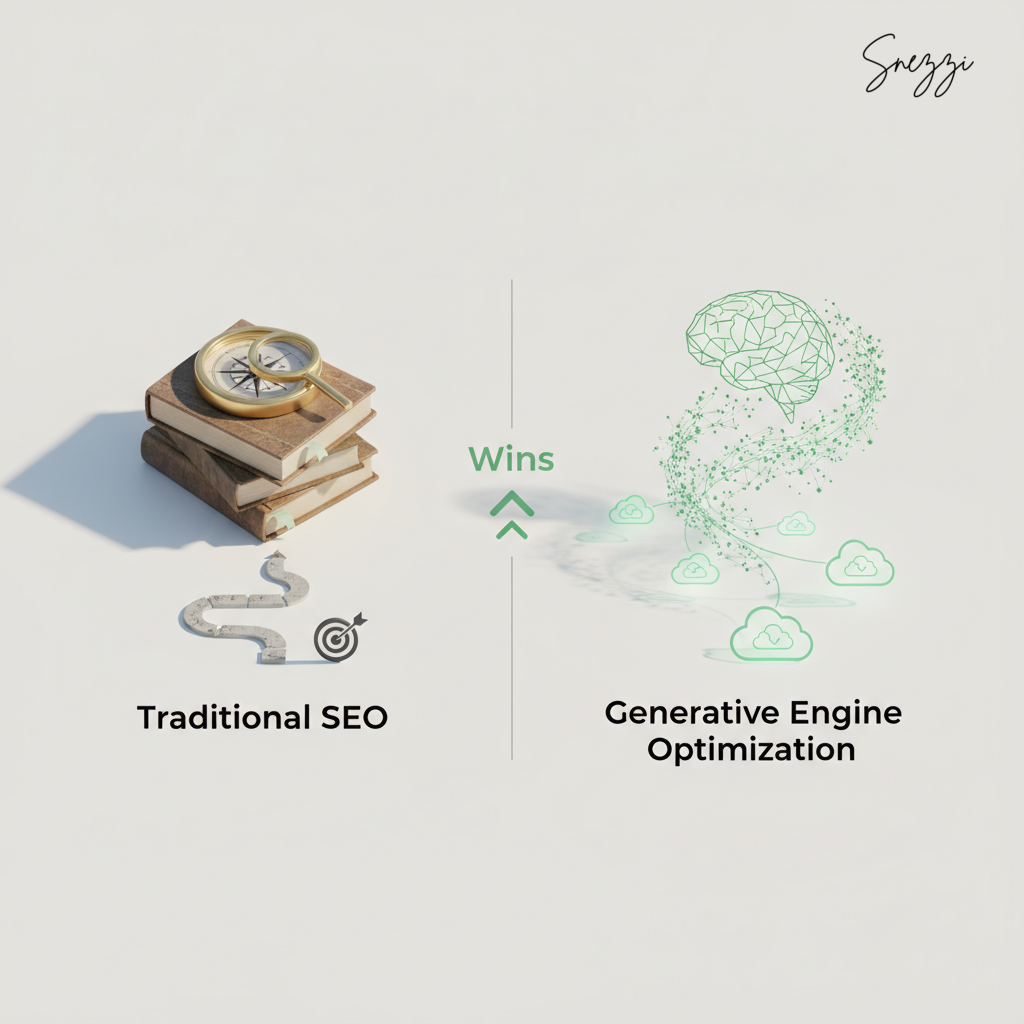
Search engines are changing faster than ever before. You probably use Google every day. But now, you might also ask questions to tools like ChatGPT or Perplexity. This shift changes how businesses get found online. It creates a battle of generative engine optimization vs traditional SEO.
Most business owners know about SEO. It stands for Search Engine Optimization. It helps your website rank high on list-based search results. But there is a new player in town. It is called GEO, or Generative Engine Optimization.
If you’re asking whether GEO is better than traditional SEO, the short answer is you need both. They do different things. SEO helps you rank on a list of blue links. GEO helps your brand appear as a direct answer in an AI conversation.
You cannot ignore this shift in 2025. Your customers are already using AI to find products. If you do not adapt, you risk becoming invisible. This guide breaks down exactly how to win at both.
You need to know what GEO is before you can use it. It is not just a buzzword. It is a specific way to format content for AI.
Generative Engine Optimization (GEO) is the process of optimizing content for AI search engines. These engines do not just list websites. They read content and summarize it for the user. When you ask an AI a question, it builds a unique answer.
GEO ensures your brand is part of that answer. According to research from Princeton University and Georgia Tech, GEO techniques can boost visibility by up to 40% in generative engine responses. This is a huge opportunity for early adopters. You are not fighting for a click. You are fighting for a mention.
Traditional search engines look for keywords. AI engines look for meaning and facts. They read millions of pages to learn about a topic. Then, they construct an answer word by word.
To win here, you must speak the AI’s language. This means being clear, factual, and easy to quote. AI engines prefer content that connects dots logically. We will discuss specific techniques to help you do this later.
Key Insight: Think of SEO as organizing a library shelf. Think of GEO as teaching a librarian so they can recommend your book.
It is easy to confuse these two strategies. They share some goals, but the methods differ. Let’s look at the main differences.
Traditional SEO focuses on rankings and clicks. You want to be the first link. You measure success by how many people visit your website.
In contrast, GEO targets citations in AI responses. Success here looks different. You want the AI to mention your brand name or product as a solution. A user might never click your website. But if the AI says you are the best choice, they might buy from you anyway.
This distinction is vital. While SEO focuses on rankings and clicks, GEO targets citations in AI responses.
SEO often requires long content to keep people on the page. You might write 3,000 words to cover every keyword.
GEO prefers direct facts. AI engines want the answer quickly. They look for authoritative statements they can verify. Clear structure is more important than length.
| Feature | Traditional SEO | Generative Engine Optimization (GEO) |
|---|---|---|
| Primary Goal | Top ranking on search page | Direct citation in AI answer |
| User Action | Click a link | Read the answer |
| Key Metric | Traffic and clicks | Brand mentions and visibility |
| Content Style | Keyword-rich and lengthy | Fact-based and concise |
| Target Audience | Human reader and crawler | AI models |
You might think SEO is dead. That is not true. Traditional SEO is still the foundation of your digital house.
Your website must work well. It needs to load fast. It must be easy for bots to crawl. If a search engine cannot read your site, an AI engine cannot either.
One key element here is structured data. This is code that tells engines exactly what is on your page. It helps both Google and AI tools. The same Princeton study found that adding statistics and citations significantly improves AI citation rates. This proves that good technical SEO supports your GEO efforts.
Authority still matters. Search engines trust sites that other sites link to. This concept applies to AI as well.
If many trusted sources talk about your brand, AI models learn to trust you. Authority building through credible content enhances trustworthiness. You cannot fake this. You must earn it through high-quality work and real partnerships.
Keywords are not gone, but they have changed. You used to stuff keywords into text. Now, you need to understand user intent.
Ask yourself what problem the user has. Are they looking to buy or learn? Write for that intent. This helps you rank in Google. It also helps AI understand your purpose.
You might wonder if this applies to you. If you run a small business or a growing team, it absolutely does.
People are tired of scrolling past ads. They want direct answers. They specifically ask AI tools for recommendations.
Imagine a user asks, “What is the best software for small teams?” An AI will list three or four options. If you are not on that list, you do not exist to that user. This is why you must care about optimizing content for ai engines.
Traditional SEO is hard for small teams. Big companies have huge budgets for links. They dominate the top spots on Google.
GEO offers a fresh start. AI cares more about relevance than budget. If you have the best answer, you can win. This gives smaller brands a chance to compete with giants.
It is hard to track success in AI. There is no simple dashboard like Google Analytics yet. You often have to check manually or use specialized tools.
This is where a visibility strategy becomes key. You need to know if you are showing up. Learn how to measure GEO visibility effectively. For growing teams, the Growth Plan helps track and improve this presence efficiently. It allows you to see where you stand without successful manual searches.
Pro Tip: Ask AI questions about your own industry. See who comes up. If it is not you, look at what your competitors are writing.
You should not choose one over the other. The best strategy uses both. We call this a hybrid approach.
You do not need to rewrite everything. You can tweak your current content. Start by adding clear definitions to your blog posts.
Add a “Key Takeaways” section at the top. This gives AI a summary to read. Ensure your facts are up to date. The GEO research shows methods like citing sources and adding statistics can improve visibility by 30-40%. This proves the power of combining GEO with strong SEO fundamentals.
Here is a simple list to get you started:
This process takes time. However, it builds a strong defense against changes in search algorithms.
It is a balance. You want to sound natural to humans. But you also want to be structured for machines.
Write in short sentences. Use bullet points often. Avoid fluff. This style is great for mobile readers. It is also perfect for AI processors. When you respect the reader’s time, you win on all fronts.
If you need a roadmap for this, the Business Plan offers the tools needed to measure success and take actionable steps. It helps you blend these strategies without guessing.
By now, you see the complexity. You have to track Google, ChatGPT, Claude, and more. It is a lot of work.
You cannot search for your brand on every AI tool every day. The results change based on the user. Also, you might not know which questions drive traffic.
Many businesses try to do this manually. They waste hours. They miss important data. You need a way to automate this process.
A platform like Snezzi solves this problem. It is designed for this specific new era. It does not just look at keywords. It looks at conversational relevance.
It helps you understand what AI thinks of your brand. Does it know your products? Does it trust your data? Knowing this allows you to fix gaps in your content.
Large companies have thousands of pages. Managing GEO for a massive site is a huge task. You need to ensure consistent messaging across all AI platforms.
For large organizations, the Enterprise Plan provides the scale needed for comprehensive AI optimization. It ensures that every part of your brand is visible and accurate in the age of AI.
The world of search will keep changing. Here is what to watch for in late 2025 and beyond.
Soon, AI will not just answer questions. It will do tasks. It might book appointments or buy products. This is called Agentic AI.
You need to be ready. Your content must explain how to buy your product clearly. If the AI cannot figure out the price or process, it cannot help the user buy.
Voice search is getting smarter. It uses the same tech as generative AI. People speak naturally to their devices.
Your content should sound like a conversation. Read your text out loud. If it sounds stiff, change it. Natural language is the key to future rankings.
Fake news is a problem for AI. Engines are getting stricter about sources. They only want to cite verified facts.
This means you must cite your sources too. Link to government data or academic studies. This proves you are telling the truth. It makes AI feel safe quoting you.
Here are answers to common questions about generative engine optimization vs traditional SEO.
SEO focuses on ranking websites in a list of search results. GEO focuses on getting content cited or summarized in AI-generated answers. SEO chases clicks, while GEO chases brand visibility in conversations.
GEO techniques format your content so AI models can easily read and understand it. Studies show this can boost visibility by up to 40% in generative engine responses. It helps you appear as a trusted recommendation.
No, you should not ignore traditional SEO. Traditional search engines still drive a massive amount of traffic. A hybrid strategy that uses strong technical SEO to support GEO is the most effective approach.
Yes, backlinks help establish authority and trust. AI models look for credible sources that others trust. Authority building through credible content enhances trustworthiness, which is vital for both search types.
No, GEO is excellent for small businesses and growing teams. It allows smaller brands to compete based on content quality rather than just budget. It levels the playing field for niche experts.
Tracking involves monitoring brand mentions and citations in AI responses. Since traditional analytics tools do not capture this, you often need specialized platforms. Tools like Snezzi are built to track this specific type of visibility.
The first step is to answer your customers’ questions directly and clearly. Use simple language and structure your data so machines can read it. Focus on being the best factual answer in your niche.
The digital landscape is shifting. The debate of generative engine optimization vs traditional SEO is not about picking a winner. It is about evolution.
You must keep your website strong with technical SEO. But you must also open the door to AI with GEO. This ensures you are found by people searching on Google and people asking ChatGPT.
Start small. Clear up your content. Add facts and citations. If you are ready to take control of your AI presence, consider how Snezzi can help you measure and improve. The future of search is here. Make sure your business is part of the conversation.