Google vs ChatGPT: Compare SEO Visibility in Minutes
Compare SEO Visibility Across Google and ChatGPT Results in minutes. See where you show up, why, and what to fix with Snezzi for US searchers.
Compare SEO Visibility Across Google and ChatGPT Results in minutes. See where you show up, why, and what to fix with Snezzi for US searchers.
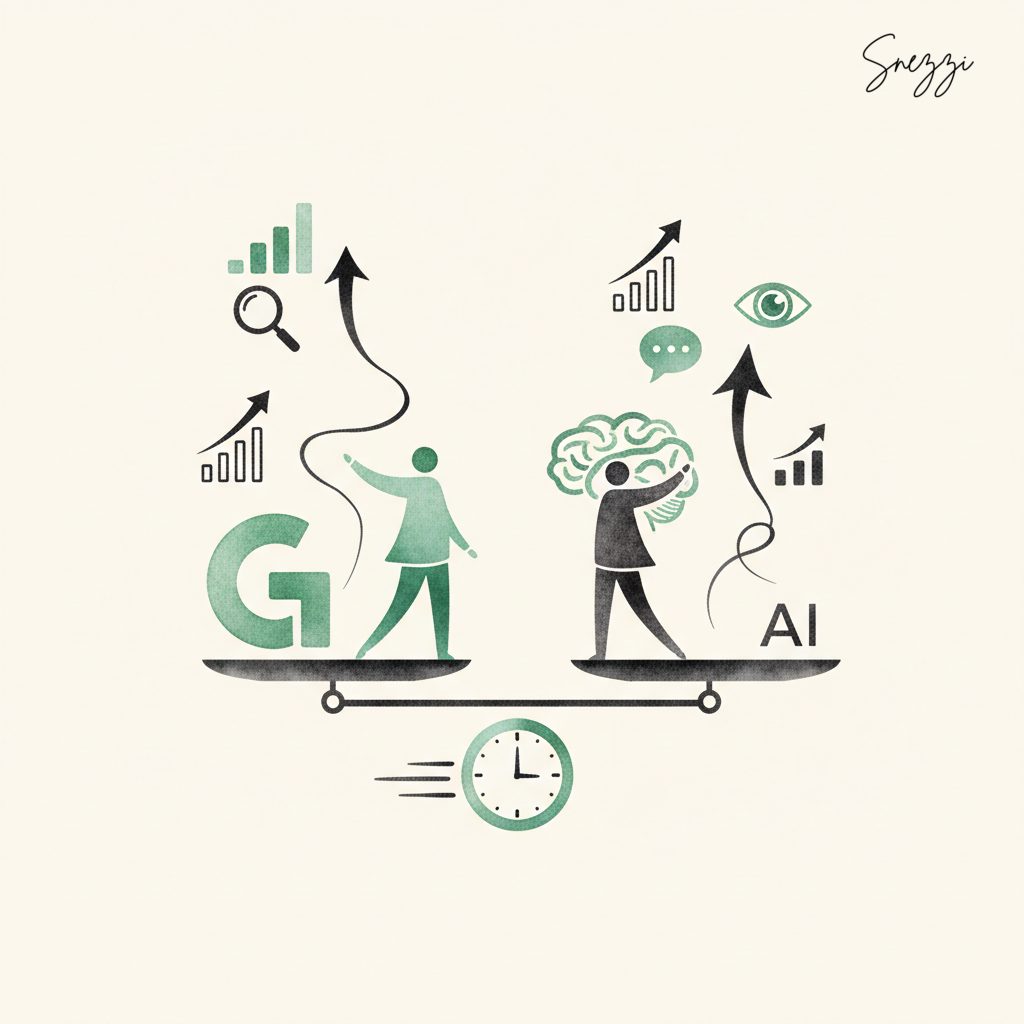
When you search for your brand on Google, you see where you rank among millions of results. But if someone asks ChatGPT about your business, you might not even appear in the answer. According to recent research from SparkToro, Google received roughly 373 times as many searches as ChatGPT in 2024, yet ChatGPT’s search-like use is growing fast enough to be considered a distinct discovery channel rather than a rounding error. This means business visibility now spans two separate worlds: traditional search engine rankings and AI-generated responses.
If you’re wondering whether your Google SEO success translates to AI visibility, the short answer is: probably not consistently. Understanding how to compare SEO visibility across Google and ChatGPT results has become essential for brands that want to maintain comprehensive online discoverability as consumer search behaviors evolve.
Rankings and AI citations now shape discovery through completely different mechanisms. Traditional search results show your website among multiple options, while AI responses often mention your brand within a single, authoritative-sounding answer. This fundamental difference means high Google rankings don’t guarantee AI mentions, and strong AI presence doesn’t ensure search visibility.
The shift creates new competitive dynamics. Your competitors might dominate AI responses while ranking poorly in Google, or vice versa. Without monitoring both channels, you’re essentially flying blind through half of the modern discovery landscape.
Effective visibility comparison requires tracking specific metrics across both platforms. In Google, you monitor impressions, click-through rates, and ranking positions. For AI responses, you need to track brand mentions, citation frequency, sentiment of descriptions, and share of voice against competitors.
A 2025 analysis of 62 queries found Google’s top three organic results typically capture 60–70% of all clicks, underscoring how impressions and click distribution concentrate at the top of the SERP. This concentration makes position tracking critical in traditional search. Meanwhile, AI responses don’t have traditional “positions” – your brand either gets mentioned or it doesn’t, making citation frequency and context quality the primary metrics.
Query coverage analysis reveals which search terms trigger brand mentions across both platforms. This helps identify gaps where you might rank well in Google but remain invisible in AI responses, or where AI systems mention you but Google doesn’t surface your content prominently.
Small businesses benefit from visibility comparison by identifying the most efficient channels for their limited resources. Industry benchmarks for 2024 show that organic search drives a median 36–40% of total website sessions across many B2C and B2B sectors in the United States. Understanding which queries drive AI mentions helps small teams prioritize content creation and optimization efforts.
Growing teams can use comparative analysis to guide scaling decisions. If AI responses consistently mention competitors but ignore your brand for key industry terms, it signals a need for content strategy adjustments or source authority building.
Enterprises require comprehensive monitoring across thousands of queries and multiple product lines. Visibility gaps between Google and AI responses can indicate market positioning risks or emerging opportunities for thought leadership in AI-driven discovery.
Google’s ranking algorithm considers hundreds of factors including page authority, backlink profiles, content relevance, user engagement signals, and local business information. The search engine evaluates individual pages and ranks them based on query match and authority indicators.
Local businesses particularly benefit from Google’s geographic features. In 2024, multi-location brands achieved an average 33.4% presence in Google’s local pack (3-pack) for their most competitive keywords in U.S. markets, up from 23.8% in 2022. This local pack visibility doesn’t translate directly to AI responses, which typically lack geographic specificity unless explicitly requested.
Rich results, featured snippets, and knowledge panels give brands additional visibility opportunities in Google beyond basic organic listings. These enhanced features require specific optimization strategies and structured data implementation.
ChatGPT builds responses by synthesizing information from multiple sources rather than ranking individual pages. The AI system prioritizes sources that demonstrate expertise, authority, and trustworthiness, but applies these criteria differently than Google’s algorithm.
A 2025 clickstream study of 80 million records found that about 70% of ChatGPT queries are unique to the assistant and not mirrored in traditional search patterns, with many longer, conversational prompts averaging over 20 words. These extended queries allow for more specific, detailed responses that can mention brands within comprehensive explanations rather than simple lists.
Brand mentions in AI responses occur within contextual discussions rather than as standalone results. This means your brand might appear in answers about industry trends, product comparisons, or solution recommendations without the user specifically searching for your company name.
The disconnect between Google rankings and AI visibility creates predictable patterns. Educational content often performs better in AI responses than in traditional search results, while commercial pages might rank highly in Google but rarely get cited by AI systems.
A 2025 study of 15 brands across five categories found only a 62% overlap between brands that ranked on Google’s first page and those mentioned in ChatGPT answers for the same queries, with almost no correlation between Google rank and ChatGPT position. This lack of correlation means successful SEO strategies don’t automatically create AI visibility.
Technical documentation and academic sources frequently appear in AI responses even when they don’t rank prominently in Google. Conversely, highly optimized commercial content might dominate Google results while being ignored by AI systems that prefer neutral, informational sources.
Start by identifying your most important search terms – typically 20-50 queries that drive the majority of your qualified traffic. Research on AI search behavior in 2025 shows that Google still handles more than 14 billion searches per day while ChatGPT processes tens of millions of search-like prompts daily, indicating brands must prioritize a defined set of high-value queries to compare efficiently.
Document your current Google rankings for these priority terms using your preferred SEO tool or manual checking. Then input the same queries into ChatGPT and record whether your brand appears in responses, how it’s described, and what context surrounds the mention.
For systematic comparison, platforms like Snezzi automate this process by tracking both Google rankings and AI citations across your query set. The platform’s Growth Plan allows businesses to monitor up to 1,000 keywords while tracking competitor presence in AI responses, making the comparison process scalable rather than manual.
Understanding competitor performance across both channels reveals market positioning opportunities. Traditional competitive SEO analysis shows which brands rank for your target keywords, but AI citation analysis uncovers different competitive dynamics.
A 2025 analysis of ChatGPT-driven traffic found that the assistant sends disproportionate referrals to educational resources, academic publishers, and technical documentation sites compared to traditional search engines. This means your industry competitors in AI responses might be completely different from your Google ranking competitors.
Monitor which brands consistently appear in AI responses for your target queries. Note the context of mentions – are they presented as leaders, alternatives, or warnings? This competitive intelligence helps inform content strategy and positioning adjustments.
AI systems draw information from a vast ecosystem of websites, publications, and databases. By November 2024, ChatGPT was recorded sending traffic to more than 30,000 unique domains, with especially strong visibility for education and technology content.
Identifying the sources that AI systems prefer for your industry helps guide content partnership and publication strategies. If academic journals consistently get cited for industry topics, consider contributing research or guest content to these publications. If trade publications dominate AI responses, focus on building relationships with those outlets.
Citation source analysis also reveals authority building opportunities. When AI systems consistently cite certain websites for industry information, those become targets for backlink building, content collaboration, or source relationship development.
AI systems rely heavily on clear entity definitions and consistent information to accurately identify and describe brands. Studies of AI search behavior in 2025 note that AI systems depend on clear entity definitions, structured content, and consistent brand naming to resolve which organization a query refers to, especially when multiple entities share similar names.
Audit your online presence for entity consistency. Ensure your brand name, description, and key attributes remain consistent across your website, social profiles, directory listings, and content publications. Inconsistent information confuses AI systems and reduces citation likelihood.
Implement structured data markup on your website to help both Google and AI systems understand your business entity, products, and services. Schema markup provides clear signals about your organization that both traditional crawlers and AI training processes can interpret.
Pro Tip: Create comprehensive “About” pages that clearly define your company, products, and industry positioning. Use consistent language that matches how customers describe your business, as this improves entity recognition across all discovery channels.
Long-tail terms account for over 70% of all search queries, and in AI search environments these specific, question-like phrases are increasingly likely to surface as full-sentence prompts. Building clear, detailed answers to specific questions creates content that both Google and AI systems can confidently reference.
Focus on creating authoritative, well-sourced content that demonstrates expertise without heavy promotional language. AI systems prefer neutral, informational sources, while Google values comprehensive content that satisfies user intent. The overlap creates opportunities for dual-channel optimization.
Develop relationships with authoritative publications and websites in your industry. Guest content, expert quotes, and collaborative research help establish your brand as a credible source that AI systems will reference when discussing industry topics.
Traffic from AI chatbots grew by roughly 81% over a recent 24‑month period, while traditional search engine traffic dipped by about 0.5%, signaling that AI visibility is becoming a moving target that requires continuous monitoring rather than one-off audits.
Set up automated monitoring for both Google rankings and AI citations using tools designed for dual-channel tracking. Snezzi’s Business Plan includes real-time alerts when your brand appears or disappears from AI responses, plus competitive intelligence showing when competitors gain visibility advantages.
Regular monitoring reveals trends that inform strategic adjustments. If competitors consistently gain AI mentions while your Google rankings remain stable, it indicates a need for content strategy evolution or source authority building.
Key Insight: The most successful brands treat Google and AI visibility as interconnected but distinct optimization challenges. Success requires monitoring both channels, understanding their different signals, and creating content strategies that serve both traditional search and AI citation goals.
Monitor your visibility monthly for priority keywords, with weekly checks during active optimization campaigns. AI responses change more frequently than Google rankings, so increased monitoring frequency helps identify sudden shifts in brand visibility or competitor movements.
No, Google rankings don’t guarantee AI citations. Research shows only 62% overlap between top Google results and ChatGPT mentions for the same queries. The systems use different signals and prefer different content types, requiring separate optimization strategies.
Educational content, detailed explanations, academic sources, and neutral informational pages perform well in AI responses. Commercial content might rank highly in Google but rarely gets cited unless it provides substantial educational value alongside promotional information.
Yes, especially for service-based queries and industry education. While AI responses lack Google’s local pack features, they influence brand perception when potential customers research services or compare options in their area.
Use automated monitoring tools to track which brands appear in AI responses for your target keywords. Manual checking works for small query sets, but scalable monitoring requires platforms designed for AI citation tracking alongside traditional SEO metrics.
Assuming Google ranking success automatically creates AI visibility. The systems operate independently and require different optimization approaches. Focus on building authority and expertise that serves both channels rather than optimizing for one platform alone.
AI queries tend to be longer, more conversational, and question-focused compared to traditional keyword-based searches. Users often ask complete questions or request explanations, creating opportunities for brands to be mentioned within comprehensive answers rather than simple result lists.
Comparing SEO visibility across Google and ChatGPT results reveals a new reality: successful online presence requires optimization for multiple discovery channels with different rules, signals, and user behaviors. The brands that thrive in this environment treat traditional search and AI visibility as complementary rather than competing priorities.
Your Google rankings provide the foundation, but AI citations extend your reach into conversational discovery experiences that increasingly influence purchase decisions. By monitoring both channels, understanding their unique requirements, and creating content that serves multiple discovery paths, you position your brand for comprehensive online visibility.
Ready to see how your brand performs across both Google rankings and AI responses? Snezzi makes it simple to track, compare, and optimize your presence across all major discovery channels. Get your free website audit to discover exactly where your brand appears — and where it’s missing — in the new world of AI-powered search.