Using LLM Sentiment and Tone Analysis for Content Strategy
Learn how Sentiment & Tone Analysis by LLMs guides content strategy. Snezzi helps businesses optimize AI visibility on ChatGPT, Claude, and more for better reach.
Learn how Sentiment & Tone Analysis by LLMs guides content strategy. Snezzi helps businesses optimize AI visibility on ChatGPT, Claude, and more for better reach.
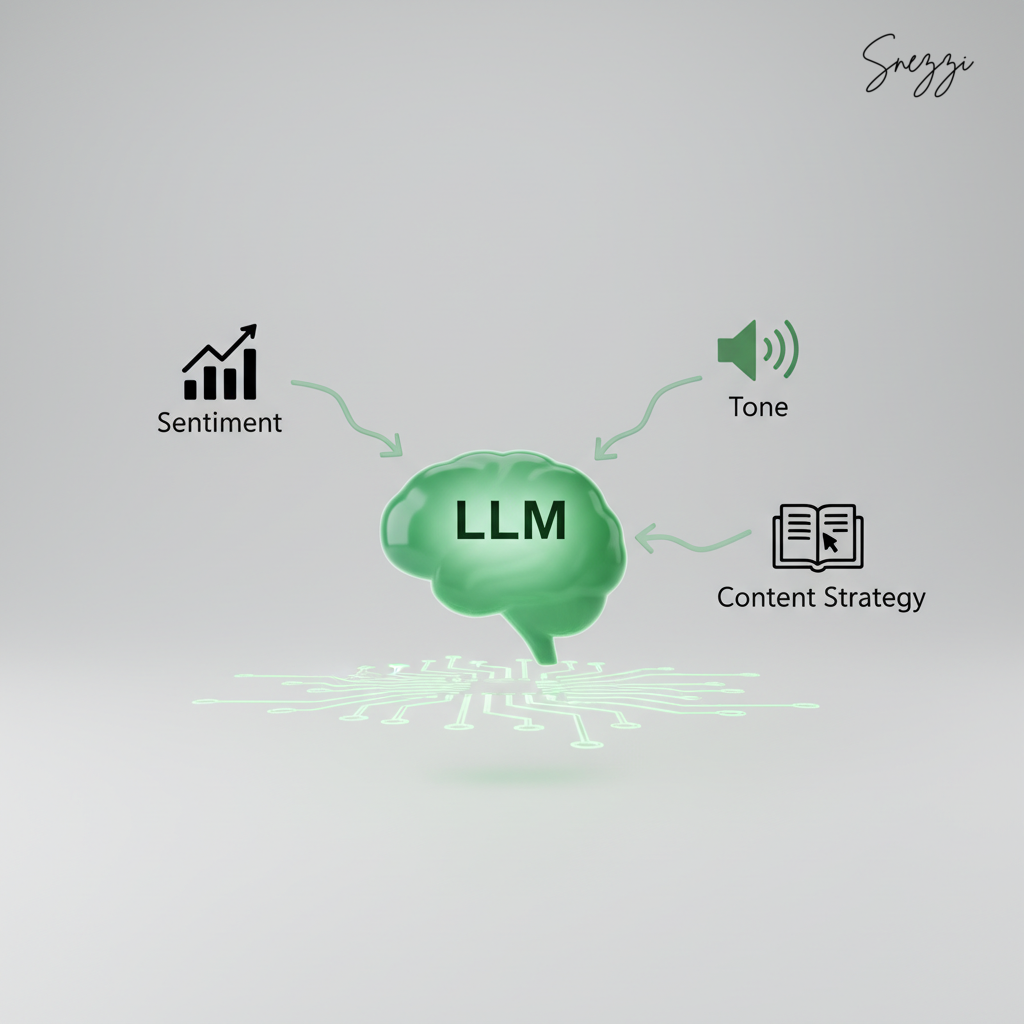
Large language models have fundamentally changed how we analyze and understand text sentiment, achieving remarkable accuracy rates of 85-95% in recent studies. If you’re wondering whether LLMs can truly capture the nuanced emotional undertones that drive audience engagement, the answer is a resounding yes—but only when implemented strategically. Modern businesses are discovering that sentiment and tone analysis by LLMs goes far beyond simple positive or negative classifications, offering sophisticated insights that can transform content strategy and audience connection.
The challenge isn’t whether LLMs can detect sentiment effectively—it’s knowing how to leverage their capabilities to optimize content for both human readers and AI-powered search systems. This comprehensive analysis explores practical implementation strategies, real-world applications, and optimization techniques that forward-thinking organizations use to enhance their digital presence through intelligent sentiment analysis.
Sentiment analysis categorizes text into positive, negative, or neutral classifications, with LLMs achieving competitive and often superior performance compared to traditional models across English datasets in 2024 research. This remarkable precision stems from LLMs’ ability to understand contextual nuances that traditional keyword-based tools miss entirely. Unlike basic sentiment classifiers that rely on predefined word lists, modern LLMs process entire paragraphs to understand implicit meanings and cultural references.
The accuracy advantage becomes particularly evident when analyzing complex business content. Marketing copy, customer feedback, and brand communications often contain layered messaging that requires sophisticated interpretation. LLMs excel at identifying subtle sentiment shifts within single documents, enabling content creators to understand how different sections might impact reader perception.
For businesses optimizing content across multiple platforms, this level of accuracy translates to more reliable insights. Content that appears neutral through traditional analysis might reveal hidden negative undertones when processed through advanced LLM systems, allowing for proactive adjustments before publication.
Beyond basic sentiment, LLMs demonstrate sophisticated multilingual capabilities, detecting formal, informal, sarcastic, enthusiastic, authoritative, and conversational variations across languages according to 2024 research on cross-lingual sentiment analysis. This granular tone detection enables content creators to ensure their messaging aligns perfectly with intended audience expectations and brand voice guidelines.
Professional tone analysis reveals patterns that significantly impact audience engagement. A formally written piece intended for casual social media might feel disconnected from platform norms, while overly casual content in professional settings can undermine credibility. LLMs identify these mismatches before content reaches audiences, saving organizations from potential brand perception issues.
The multilingual capability particularly benefits global organizations managing content across diverse markets. Cultural tone preferences vary significantly between regions, and LLMs help maintain appropriate voice consistency while adapting to local communication styles.
LLMs process audience reactions through advanced pattern recognition, with GPT-4o achieving the highest overall accuracy in 2025 comparative studies against dedicated neural networks. This predictive capability stems from their training on vast datasets of human communication patterns, enabling them to anticipate how specific word choices and sentence structures will resonate with target audiences.
The simulation process considers multiple factors simultaneously: word choice emotional weight, sentence structure complexity, cultural context, and industry-specific communication norms. Traditional sentiment tools analyze individual elements separately, while LLMs integrate these factors for holistic audience reaction predictions.
This predictive insight proves invaluable for content optimization strategies. Organizations can test multiple message variations against predicted audience responses, selecting options most likely to generate desired engagement levels before investing in full content development or advertising campaigns.
Strategic content audits reveal significant opportunities for improvement. Research shows that branded content requires a deliberately softer, more audience-oriented tone according to 2025 marketing studies, indicating the importance of alignment between intended messaging and actual content delivery. These mismatches often occur when multiple team members contribute to content creation without centralized tone guidelines.
Performance analysis through LLM evaluation provides objective feedback on content effectiveness. Rather than relying on subjective editorial reviews, organizations can quantify how well their content achieves intended emotional impact. This data-driven approach eliminates guesswork from content optimization decisions.
Regular sentiment audits also identify content pieces that perform unexpectedly well or poorly. Understanding the sentiment characteristics of high-performing content enables teams to replicate successful approaches across other materials, creating more consistent audience engagement patterns.
Audience-specific messaging refinement yields measurable results. Research shows that businesses embracing advanced analytics have seen a 30% increase in engagement compared to those relying solely on basic metrics, according to 2023-2025 data analysis. This improvement stems from LLMs’ ability to identify subtle language preferences that resonate with specific demographic and psychographic segments.
The refinement process involves analyzing successful competitor content, identifying tone patterns that drive engagement within target markets, and adjusting messaging to align with proven preferences. LLMs can process vast amounts of successful content to extract actionable insights about effective communication approaches for specific audiences.
Personalization extends beyond basic demographic targeting to include industry-specific communication styles, professional role preferences, and even regional language variations. LLMs help organizations create messaging that feels natural and relevant to each audience segment without requiring extensive manual analysis.
Workflow integration maximizes sentiment analysis benefits. Sentiment analysis tools enable viewing key insights like performance metrics to optimize brand messaging, with advanced systems helping organizations catch tone and sentiment issues during initial creation rather than after full content development. This efficiency gain comes from catching tone and sentiment issues during initial creation rather than after full content development.
The feedback integration process works best when implemented at multiple creation stages. Initial concept development, first draft completion, and final editing phases each benefit from sentiment evaluation. Early-stage feedback prevents fundamental tone misalignment, while later-stage analysis fine-tunes emotional impact.
Successful organizations establish clear sentiment guidelines based on brand voice requirements and audience preferences. Content creators can reference these guidelines alongside LLM feedback to ensure consistency across all materials while maintaining creative flexibility within established parameters.
Content visibility on AI platforms increasingly depends on sentiment relevance. Research shows that in AI search, visibility alone doesn’t mean much if the mention comes with negative or lukewarm sentiment, with 2024 analysis revealing how sentiment varies significantly across different AI platforms. This preference stems from AI systems’ tendency to prioritize content that provides helpful, constructive information to users seeking solutions.
Monitoring citation patterns reveals how sentiment affects content discoverability. Organizations using platforms like Snezzi can track which content pieces generate AI citations and identify sentiment characteristics that correlate with higher visibility rates. This insight enables strategic content optimization for improved AI platform performance.
Citation monitoring also reveals competitive positioning opportunities. Understanding how competitor content performs in AI responses helps organizations identify sentiment gaps they can fill with superior content that better serves user intent and receives preferential treatment from AI systems. For more on optimizing AI citations, see our guide on getting citations right in AI-generated answers.
Competitive sentiment analysis uncovers significant market opportunities. Each AI engine applies its own sentiment framework, filtering brand narratives through distinct interpretation systems, with platforms leaning positive, neutral, or skeptical in different ways according to 2024 analysis. These gaps represent opportunities for organizations to provide more positive, solution-focused content that AI systems prefer for user recommendations.
Intelligence gathering involves analyzing competitor content sentiment patterns, identifying areas where negative or neutral content dominates search results, and developing superior alternatives with more positive, helpful tones. Organizations that proactively address these gaps often see rapid improvements in AI platform visibility.
Snezzi’s competitive analysis features help organizations identify these opportunities systematically. By tracking sentiment patterns across competitor content and monitoring AI platform citation trends, businesses can develop data-driven content strategies that capitalize on market gaps.
Strategic implementation requires specific, actionable guidance. AI sentiment analysis provides emotion and tone detection that identifies emotional cues based on word choice, syntax, and context, enabling organizations to translate analysis results into actionable content improvements. The key lies in translating sentiment analysis results into specific content improvement strategies that content creators can implement immediately.
Effective recommendations address specific content elements: word choice alternatives, sentence structure adjustments, paragraph-level tone modifications, and overall message positioning. Rather than providing vague suggestions to “improve tone,” successful systems offer concrete alternatives that maintain content meaning while enhancing emotional impact.
Organizations benefit most from recommendation systems that integrate with existing content workflows. Snezzi provides this integration through its optimization platform, delivering specific improvement suggestions that content teams can implement without disrupting established creation processes.
Sentiment data correlation with engagement outcomes provides clear optimization targets. Analyzing the tone of conversations through engagement measurement tools helps identify areas that need attention, with positive sentiment indicating healthy, engaged audiences according to 2025 community metrics research. This correlation enables organizations to predict content performance based on sentiment analysis results before publication.
Engagement measurement extends beyond basic metrics like clicks and shares to include more sophisticated indicators such as comment sentiment, share context, and user session duration. LLM analysis helps identify content characteristics that drive these deeper engagement signals, providing insights for future content development.
The measurement process benefits from establishing baseline sentiment scores for existing high-performing content. Organizations can then optimize new content to match or exceed these sentiment benchmarks, creating more predictable engagement outcomes across content campaigns. Learn more about tracking performance metrics in our article on measuring AI visibility ROI.
Agile content optimization responds to immediate market feedback. Sentiment analysis combined with real-time data processing significantly improves engagement metrics like click-through rates and conversions, with organizations able to adjust messaging quickly based on audience response patterns. This responsiveness proves crucial in rapidly changing market conditions where audience sentiment can shift quickly.
Real-time adjustment capabilities allow organizations to modify content tone based on immediate audience feedback, trending topics, or competitive developments. Rather than waiting for comprehensive campaign analysis, teams can make tactical adjustments that maintain optimal sentiment alignment with current market conditions.
Successful real-time optimization requires automated monitoring systems that flag significant sentiment shifts in audience feedback or competitive content. Organizations using comprehensive platforms like Snezzi can establish alert systems that notify teams when content adjustments might be beneficial.
Large-scale implementation multiplies sentiment analysis benefits significantly. Research shows that 44 percent of AI-powered search users say it’s their primary and preferred source of insight, highlighting the importance of optimizing content sentiment for AI visibility. This improvement stems from consistent tone application across all content touchpoints, creating cohesive brand experiences that AI systems recognize and prioritize.
Enterprise scaling involves establishing organization-wide sentiment guidelines, training content teams on LLM analysis tools, and implementing systematic monitoring across all content channels. The coordination effort pays dividends through improved brand consistency and enhanced AI platform performance.
Snezzi’s enterprise solutions provide the infrastructure necessary for large-scale sentiment optimization. With features supporting multiple team members, comprehensive analytics, and automated monitoring, organizations can maintain consistent sentiment strategy across diverse content operations while gaining visibility into performance patterns across all channels. To learn more about optimizing your brand for AI platforms, see our comparison of AI visibility platforms.
LLMs achieve impressive accuracy in tone detection, with modern systems identifying over 20 distinct tones in multilingual text. Their accuracy stems from training on diverse human communication patterns, enabling them to recognize subtle contextual clues that traditional tools miss. However, accuracy varies by language, domain, and content complexity.
Yes, sentiment analysis significantly impacts SEO performance, particularly as search engines increasingly prioritize user engagement signals. Content with appropriate sentiment alignment tends to generate higher user engagement, longer session durations, and more positive user interactions—all factors that influence search rankings.
Sentiment refers to the overall emotional polarity (positive, negative, neutral) of content, while tone encompasses the stylistic approach and attitude (formal, casual, authoritative, friendly). LLMs analyze both simultaneously, providing comprehensive insights into how content will be perceived by different audiences.
Implementation speed depends on existing content workflows and technical infrastructure. Organizations with established content management systems can often integrate LLM sentiment analysis within weeks using platforms like Snezzi, which provide ready-to-use tools and actionable recommendations without requiring extensive technical setup.
Marketing copy, customer communications, social media content, and thought leadership pieces see the greatest benefits from LLM tone analysis. These content types rely heavily on emotional connection with audiences, making tone optimization crucial for achieving intended engagement and conversion outcomes.
AI platforms increasingly prioritize content with positive, helpful tones when generating responses to user queries. Content with appropriate sentiment alignment appears more frequently in AI citations and recommendations, directly impacting brand visibility and discoverability through AI-powered search systems.
Modern LLMs demonstrate strong multilingual capabilities, with many systems trained on diverse language datasets. However, accuracy levels may vary between languages, with English, Spanish, French, and other major languages typically showing higher accuracy than less common languages or highly specialized dialects.
Sentiment and tone analysis by LLMs represents a fundamental shift in how organizations can optimize their content strategy and digital presence. The evidence clearly demonstrates that businesses leveraging these advanced capabilities see measurable improvements in audience engagement, AI platform visibility, and overall content performance. From the 25% engagement increases through targeted messaging refinement to the 55% visibility improvements at enterprise scale, the data supports strategic investment in LLM-powered sentiment analysis.
The key to success lies in systematic implementation rather than ad hoc experimentation. Organizations that establish clear sentiment guidelines, integrate feedback loops into content creation workflows, and monitor performance across AI platforms position themselves for sustained competitive advantage. As AI systems become increasingly sophisticated in their content evaluation and recommendation processes, businesses that proactively optimize for sentiment alignment will dominate their markets.
For organizations ready to transform their content strategy through advanced sentiment analysis, Snezzi offers done-for-you solutions that simplify implementation while delivering measurable results. With competitive analysis, real-time monitoring, and actionable optimization recommendations, businesses can achieve enterprise-level sentiment optimization regardless of their current technical capabilities. Get your free website audit to start your journey toward enhanced AI visibility and discover how strategic sentiment analysis can elevate your digital presence across all AI platforms.