GEO for Local Businesses: Win 'Near Me' AI Answers
Learn how GEO helps local businesses appear in AI-driven "near me" searches on ChatGPT and Perplexity. Practical strategies to win AI citations and drive local foot traffic in 2026.
Learn how GEO helps local businesses appear in AI-driven "near me" searches on ChatGPT and Perplexity. Practical strategies to win AI citations and drive local foot traffic in 2026.
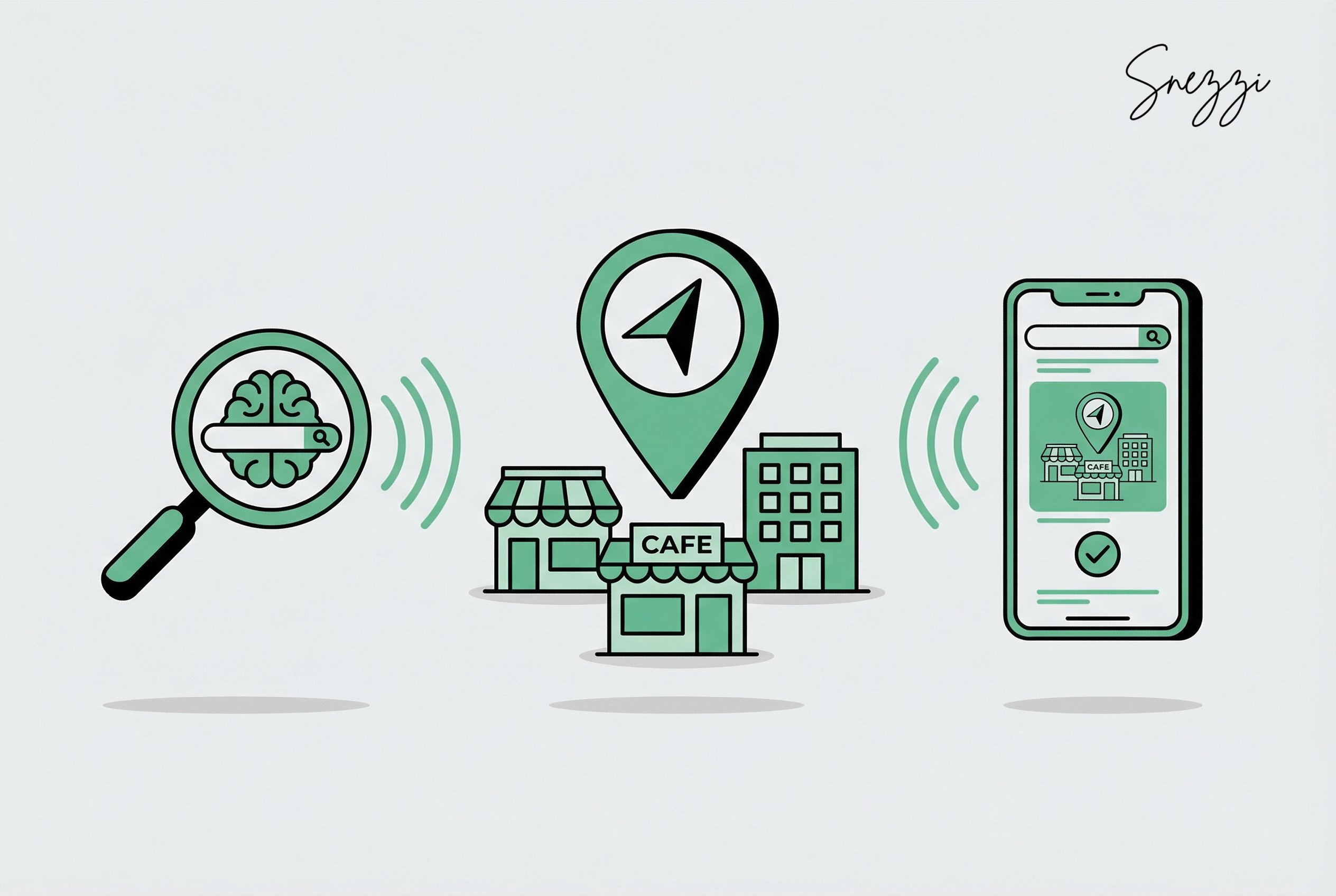
Your Google rankings look fine. But your phone stopped ringing.
The problem isn’t your SEO. It’s that 45% of consumers now use AI tools like ChatGPT and Perplexity for local recommendations, up from just 6% one year ago. When someone asks “best plumber near me” at 9 PM on a Sunday, they’re not scrolling through Google Maps anymore. They’re getting two or three AI-curated recommendations and calling one of them.
Mastering GEO for local businesses means appearing in those AI answers. The shift isn’t coming; it’s already reshaping how customers discover local services. But here’s the advantage most business owners miss: 86% of what AI uses to recommend your business comes from data you already control.
Generative Engine Optimization tailors your online presence so AI models favor your business when generating recommendations. Unlike traditional SEO, which targets search engine rankings, GEO for local businesses focuses specifically on appearing in AI-generated answers to proximity-based queries. For a clear breakdown of how the two differ, see GEO vs traditional SEO: key differences and wins.
The distinction matters. Google Maps shows ten listings and lets customers decide. ChatGPT recommends two or three businesses and makes that decision for them. AI overviews now appear in 14% of search results, including local queries, and that percentage climbs monthly.
GEO differs from keyword-focused SEO by prioritizing AI comprehension over keyword density. AI platforms use natural language processing to match user intent with authoritative local content. They’re reading for context, not counting keyword mentions. A coffee shop that answers “what makes your espresso different” with specific roasting details and origin stories gives AI models better material than a page stuffed with “best coffee near me.”
Traditional search is declining fast. Gartner predicts a 25% drop in traditional search volume by 2026 as AI chatbots replace the search bar for discovery queries. For local businesses, that’s not a threat. It’s an opening.
AI platforms scan multiple data sources simultaneously to build local recommendations. They pull from your website content, business directories, Google Business Profile, review platforms, and structured data markup. The systems then use natural language processing to evaluate which businesses best match the searcher’s specific intent.
Location matters differently in AI search. When someone asks “emergency plumber near me,” the AI considers proximity but weighs it against authority signals. A plumber 15 minutes away with detailed emergency service descriptions, recent reviews mentioning fast response times, and video testimonials showing actual work will often get recommended over a closer competitor with sparse information.
The mechanics favor businesses that document expertise. 46% of all searches have local intent, and AI platforms increasingly answer these queries directly rather than sending users to Google. ChatGPT, Perplexity, and Claude pull real-time data from maps, reviews, and structured information to ensure accuracy for proximity-based recommendations.
Recency plays a bigger role than most businesses realize. Analysis of over 8,000 businesses found that monthly review volume correlates more strongly with “near me” rankings than total review count. A dental practice pulling 60 reviews monthly dominated local AI recommendations. When they stopped for 18 days, rankings collapsed. Competitors maintaining 15 to 45 reviews per month held steady positions.
“Near me” AI answers are location-aware responses generated by platforms like ChatGPT, Perplexity, and Claude. Unlike traditional search results that show a list, these are curated recommendations that bypass the comparison phase entirely. The AI decides which two or three businesses to suggest based on relevance, authority, and proximity.
Citation sources are the high-authority platforms AI systems trust when validating local business information. Google Business Profile serves as the primary source, but AI platforms also reference industry-specific directories, review sites, and your own website. For healthcare providers, over half of AI recommendations pull from specialized medical directories most practices don’t actively manage.
Prompt tracking monitors what AI platforms say when users ask about your service category. If someone in your city asks ChatGPT for restaurant recommendations, are you mentioned? If not, why? Tracking these queries reveals optimization gaps that traditional analytics miss entirely. Our guide on how to measure GEO visibility covers the full measurement framework.
Review content quality outweighs star ratings in AI recommendations. Reviews with substantive text help AI systems understand what your business actually does well. Reviews without text matter significantly less for rankings, and one-star ratings without accompanying text don’t even display in Google Maps apps.
Start with your Google Business Profile. Complete every field with AI-friendly descriptions that explain what you do, who you serve, and what makes you different. Upload photos showing actual work, your team, and your location. The profile feeds multiple AI platforms, making it foundational infrastructure for local GEO.
Address visibility matters more than Google admits. Research analyzing thousands of businesses found a negative correlation between hiding your address and ranking for “near me” queries. Service-area businesses that showed real office addresses ranked consistently higher than those hiding locations, contradicting official Google guidance.
Create location-specific content answering common questions customers ask AI. A tax accountant should publish content about how recent tax law changes affect small business owners in their state, not generic retirement planning articles. A home services company should document what different projects look like in their region, with actual client situations and measurable results.
Build citations across directories AI platforms check. Different industries have different citation sources. Dental practices need profiles on specialized dental directories that ChatGPT references. Restaurants need updated information on food-specific platforms. Research which directories AI checks for your vertical, then ensure your NAP data (name, address, phone) stays consistent across all of them. For a deeper look at citation strategy, see sources and citations in AEO: trust verified data.
Earn reviews consistently, not in bursts. Monthly review velocity predicts sustained “near me” visibility better than total volume. Encourage detailed reviews that mention specific services, outcomes, or experiences. That text gives AI systems the context they need to recommend you confidently.
Optimize your landing pages with substantive content. Analysis found a correlation between meaningful word count on linked pages and local pack rankings. This doesn’t mean keyword stuffing. It means explaining your services thoroughly, addressing common questions, and demonstrating expertise through specific examples.
For businesses just starting with GEO implementation, book a strategy session to identify which AI platforms matter most for your market and which citation sources require immediate attention.
A specialty coffee shop in Portland optimized for “coffee near me” AI queries by creating detailed FAQ content explaining their roasting process, bean origins, and brewing methods. Within three months, they ranked first in ChatGPT recommendations for coffee searches in their neighborhood, driving a 40% increase in morning foot traffic from customers who mentioned finding them through AI.
An emergency plumber in Austin dominated Perplexity results for “emergency plumber near me” by uploading video testimonials showing before-and-after work, documenting response times, and maintaining a steady flow of detailed reviews. The videos gave AI platforms visual proof of expertise that text-only competitors couldn’t match.
A multi-location gym chain working with Snezzi appeared in 80% of AI fitness queries across their markets after systematic citation optimization. The key was ensuring consistent, detailed information across 30+ directories that AI platforms reference, plus location-specific content for each facility addressing neighborhood-specific fitness questions. The custom multi-location strategy coordinated signals across sites while maintaining local relevance for each market.
These results share common elements: specific documentation of expertise, consistent citation management, and content that directly answers questions people ask AI platforms. GEO strategies yield 15 to 30% more qualified leads compared to traditional SEO alone because AI recommendations carry implied endorsement that organic listings lack.
Visibility to millions using AI for discovery represents the primary benefit. 79% of customers intend to use AI-driven search in 2026, and local businesses appearing in those recommendations access an audience that bypasses traditional search entirely. The traffic quality improves because AI pre-qualifies leads by matching them to businesses that genuinely fit their needs.
Conversion rates from AI referrals exceed traditional search traffic. When ChatGPT recommends your restaurant, that carries more weight than appearing in position seven on Google. The AI made a judgment call based on relevance and authority. Customers arrive more confident and ready to convert.
Future-proofing against search decline matters for long-term sustainability. 88% of local markets already lost organic visibility as Google replaced traditional local packs with AI-powered versions showing fewer businesses. Building AI visibility now positions you for the next decade of local discovery, not just the current quarter.
Local businesses gain a structural advantage over national competitors in GEO. National brands optimize for broad keywords and regional campaigns. They move slowly and think in corporate approval cycles. Local businesses can document hyper-specific expertise that national brands can’t replicate: neighborhood knowledge, local case studies, market-specific solutions. That specificity is exactly what AI platforms need to generate confident recommendations.
GEO isn’t just keywords in new places. The biggest mistake local businesses make is treating AI optimization like traditional SEO with a fresh coat of paint. AI platforms read for authority and context, not keyword density. Stuffing “near me” into your content won’t help. Documenting specific expertise, client results, and local knowledge will.
Traditional SEO alone won’t win AI answers. Your Google Business Profile might be perfect, but if AI platforms can’t find substantive information about what makes you different, they’ll recommend competitors with better documentation. GEO requires structured local signals across multiple platforms, not just one optimized listing.
You don’t need coding skills or technical expertise to implement GEO. The work involves content creation, citation management, and review generation, tasks most businesses already handle. Platforms like Snezzi automate the technical aspects like prompt tracking and citation source intelligence, letting you focus on running your business.
Hiding your address helps service-area businesses is perhaps the most damaging misconception. Google’s official guidance suggests hiding addresses for mobile service providers. But real-world testing shows the opposite: businesses that displayed physical addresses ranked consistently better for “near me” queries. When one home service client hid their address following Google’s advice, rankings tanked. Adding it back a month later restored visibility.
More total reviews beats recent review velocity is another myth. A business with 500 total reviews but no new reviews in six months will lose ground to a competitor with 200 reviews who consistently adds 20 per month. AI platforms and Google both favor businesses showing current customer engagement over historical accumulation.
Snezzi’s AI visibility platform tracks what ChatGPT, Perplexity, Claude, and other AI platforms say when users ask about your service category. You see exactly which competitors get recommended, which citation sources AI platforms reference, and where your information gaps exist. That visibility transforms GEO from guesswork into measurable strategy. Real-time brand mention tracking explains how continuous monitoring works across platforms.
Prompt monitoring shows real queries people ask AI about your industry. A dental practice might discover patients ask about “sedation dentistry for anxiety” far more than “general dentistry.” That insight drives content priorities and helps you answer the questions that actually generate recommendations.
Competitor analysis reveals which businesses dominate AI recommendations in your market and why. You see their citation profiles, content strategies, and review patterns. Instead of reverse-engineering success blindly, you get clear intelligence about what’s working in your specific vertical and geography.
Done-for-you services handle execution when you lack time or expertise. Snezzi’s team manages citation building, content optimization, and review generation with accountability for outcomes. The aggressive growth plan delivers rapid citation expansion and competitor prompt analysis to scale AI visibility quickly across multiple platforms.
Expert support ensures you’re optimizing for the right signals. AI platforms update their recommendation algorithms regularly. What worked three months ago might not work today. Snezzi’s 24/7 support keeps your strategy aligned with current platform behavior, preventing wasted effort on outdated tactics.
The businesses winning “near me” AI answers in 2026 aren’t the ones with the biggest budgets. They’re the ones who recognized the shift early and built systematic GEO strategies while competitors still focused exclusively on Google.
You already control most of what AI needs to recommend you: your website, your reviews, your business listings. The question isn’t whether you have the assets. It’s whether you’re optimizing them for the platforms that now drive local discovery.
Traditional search volume will drop 25% by year-end as AI chatbots replace the search bar. Local businesses that move now capture market share from slower competitors. The window for early-mover advantage stays open, but it’s closing as more businesses recognize what’s happening.
Start with measurement. Find out what AI platforms currently say when someone asks about your service category in your city. That baseline shows you exactly where you stand and what needs fixing. Then systematically address the gaps: complete your citations, generate consistent reviews, create content answering real questions, and track results monthly.
GEO for local businesses isn’t a future trend. It’s the present reality of how customers discover services in 2026. The businesses that adapt win the next decade of local search. The ones that wait play catch-up to competitors who moved when it mattered.
Generative Engine Optimization (GEO) for local businesses is the practice of optimizing your online presence so AI platforms like ChatGPT, Perplexity, and Claude recommend your business in response to proximity-based queries like “best plumber near me” or “dentist near me accepting new patients.”
To appear in AI near me searches, complete your Google Business Profile with detailed descriptions, build citations across directories AI platforms check for your industry, earn consistent monthly reviews with substantive text, create location-specific content answering common customer questions, and display your physical address rather than hiding it.
No. GEO complements traditional local SEO rather than replacing it. Your Google Business Profile and review profiles feed AI platforms the same data that drives local search. GEO adds content and citation strategies specifically designed for how AI models evaluate and recommend local businesses.
Monthly review velocity matters more than total review count. Research shows a dental practice adding 60 reviews monthly dominated local AI results, while one that paused for 18 days saw rankings collapse. Consistent, recent reviews with substantive text are the single most impactful signal for near me AI answers.
No. Despite Google’s official guidance suggesting address hiding for mobile service providers, real-world testing shows businesses displaying physical addresses consistently rank higher in near me AI queries. Service area businesses that showed real office addresses outperformed those hiding locations.